Why dealing with climate change is difficult (spinach tarts and ice cream)

[youtube]NOsl5-AUTv4[/youtube]

Let’s be clear about this: the failure to take adequate action to reduce emissions is not because of any weakness in our understanding of the science of climate. It has its roots instead in human psychology and sociology, as George Marshall explains in this series of three videos — The Ingenious Ways We Avoid Believing In Climate Change — a recording of a keynote address he gave to a conference in 2009. Marshall is a good presenter — he illustrates his points well (spinach tarts and ice cream feature prominently) — and provides a very good and concise overview of why many people prefer to ignore the climate problem. Whatever your views on the seriousness of the climate problem or how we should act to deal with it, you’ll find something in his talk to challenge your preconceptions. Parts two and three are below the fold…

Continue reading “Why dealing with climate change is difficult (spinach tarts and ice cream)”

Easterbrook adrift: WWU geology dept issues statement on climate change

Word reaches me that the geology department at Western Washington University — home of emeritus professor and data fiddler Don Easterbrook — has adopted a position statement on climate change. The statement is supported by the entire geology department, and is clearly designed to distance WWU’s geologists from Easterbrook’s odd ideas and dodgy practices. Here’s what they say:

Decades of scientific research have shown that climate can change from both natural and anthropogenic causes. The Geology Faculty at WWU concur with rigorous, peer-reviewed assessments by the National Academies of Science (2005), the National Research Council (2006), and the Intergovernmental Panel on Climate Change (IPCC, 2007) that global climate has warmed significantly and that human activities (mainly greenhouse-gas emissions) account for most of the warming since the middle 1900s. If current trends continue, the projected increase in global temperature by the end of the twenty-first century will result in large impacts on humans and other species. Addressing the challenges posed by climate change will require a combination of adaptation to the changes that are likely to occur and global reductions of carbon dioxide emissions from anthropogenic sources.

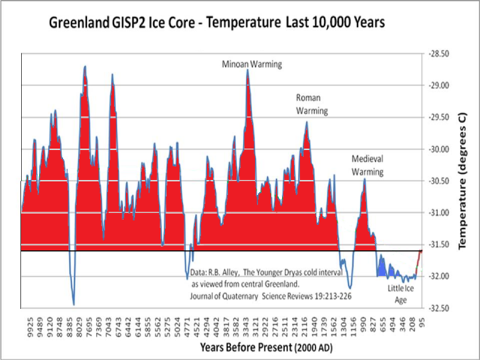
Congratulations to WWU’s geologists for taking this stand. I wonder if Easterbrook will now withdraw his claim that most of the last 10,000 years were warmer than today, apologise for stealing and altering a graph from Global Warming Art and apologise for calling me a liar? But then he is a denier, and that means never having to say you’re sorry…

Don Easterbrook’s Academic Dishonesty

A

As Don Easterbrook has shown no signs of withdrawing his article claiming that most of the last 10,000 years were warmer than present, and as his university has shown no appetite for addressing the issue, Professor Scott Mandia of the Climate Science Rapid Response Team and I decided to write to the local press. The letter below was sent to The Bellingham Herald (local newspaper) and to Western Front Online (Western Washington University newspaper) on Monday January 9, 2011. Scott also called and left a message with the Bellingham Herald News Editor. He did not hear back from either newspaper, so we’re reprinting the letter in full here and at Scott’s blog.

Sir or Madam,

Don Easterbrook, a Professor Emeritus at Western Washington University has been promoting his belief that natural cycles of the sun and oceans are going to cause global cooling over the next few decades and this will offset the CO2-caused warming headed our way. In 2001, he announced that global cooling was about to begin and would last for the next 25 years. Of course, the previous decade was the warmest in over 150 years and 2010 is likely to be the warmest or second warmest year in that period. Easterbrook wants to persuade us to ignore global warming despite the fact that most of his peers, climate scientists, military and intelligence experts, health officials, and insurance companies expect major societal disruptions due to the current and expected human-caused climate disruption.

It is ok to be wrong. Science cannot prove an idea is true but only that it is false. Correcting mistakes is how science moves forward. But Easterbrook is not just wrong, he is playing fast and loose with the data. He was caught red-handed using a doctored graph in a 2007 conference (see http://bit.ly/goEkd3) and in subsequent articles and talks. Easterbrook not only edited these graphics to change the information they contained, but did so in order to minimize the evidence of recent global warming. This is, at the very least, academic malpractice. More recently (12/28/10) he incorrectly labeled a graph of temperatures for the previous 10,000 years to claim that most of these years were warmer than present. His “current temperature” was really 1855 and not the much warmer present day. He was notified of his mistake but refuses to issue a retraction (see http://bit.ly/dW6BOk). A good scientist corrects and learns from mistakes, but this seems foreign to Easterbrook.

WWU officials were notified of Easterbrook’s doctoring of data last May and again this January but have so far chosen to do nothing. Academic freedom must be cherished and defended but dishonesty should never be condoned – whether at WWU or any other institution of higher education.

Scott Mandia and Gareth Renowden


Bios: Scott Mandia is a professor of physical sciences at Suffolk County Community College, Long Island, New York and has been teaching meteorology and climatology courses for 23 years.

Gareth Renowden is an NZ-based science writer and blogger, author of Hot Topic – Global Warming & The Future of New Zealand. He has written extensively on Easterbrook’s cavalier approach to climate data.

Everyone agrees: 2010 ties for top temperature

NASA2010temps4series.png

All of the major global temperature series — surface and satellite — report that 2010 is tied for first place as the warmest year in the long term record. NASA’s Goddard Institute for Space Studies and NOAA’s National Climatic Data Center both have 2010 tied with their previous record holder 2005, while the UK’s Climatic Research Unit and the satellite series from the University of Alabama Huntley (UAH) report that 2010 is tied with 1998. Commenting on the surface record, NZ climate scientist Jim Salinger said:

The three sources of global mean temperature analysis shows that the globe continues to warm with nine of the top ten years occurring between 2001 and 2010. Global average temperatures for the decade 2001 to 2010 were 0.44 deg C above the 1961 to 1990 average for HadCRUT3, making it the warmest decade on record going back to 1850.

Despite differences in detail between the various surface records, the GISS graph above clearly demonstrates that they show nearly identical long term trends. As the NZ Herald pointed out, 2010 should spells the end for that favourite denialist trope — it’s been cooling since (pick a year), but I’m a bit more sanguine. I confidently predict that with the current intense La Niña likely to ensure that 2011 is not a record-setter, the usual suspects will insist there’s been a plateau in temperatures, with cooling sure to follow. Until the next strong El Niño comes along, of course, because with the solar cycle moving towards maximum insolation, the global average will almost certainly set a clear new record. 2012, perhaps?

[Small milestone: This is the 1,000th post at Hot Topic since the site launched in April 2007.]

Too many teardrops

[youtube]kYUpkPTcqPY[/youtube]

This astonishing video was shot on Monday as flash flooding hit the Queensland town of Toowoomba after a reported 140mm of rain fell in only 30 minutes. 12 people are confirmed to have been killed in the region, and 90 more are missing according to state premier Anna Bligh. Floodwaters are rising in the state capital Brisbane, with the central business district closed down. Flood levels are expected to top out above the levels reached in 1974 — the previous record holder. I know that Hot Topic‘s readers will join me in wishing the people of Queensland well. This ABC page has a list of relief funds to which you can donate. I can confirm that Skeptical Science’s John Cook is OK, and not expecting any direct impacts. We’ll be talking to him about the floods in the next Climate Show, scheduled for recording next week.

Has global warming had an impact on this event? Watching the deniers quotes The Age saying that the floods are “consistent with (although not proof of) climate change predictions for northern Australia”, and that seems fair. The direct “cause” of the flooding is the current strong La Niña (possibly the strongest since records began, according to AMOS president Prof Neville Nicholls). This phase of ENSO causes warm water to pile up against NE Australia, helping to fuel large rainfall events. The record floods of 1974, for example, were associated with a La Niña event. To make matters worse, over the last year sea surface temperatures around Australia have been running at record levels, as this Bureau of Meteorology chart from their climate summary for 2010 shows:

The recipe seems clear enough: an intense La Niña and record sea surface temperatures combining to cause record floods. A more precise attribution of warming’s influence on the event will have to wait for the studies to be done, but for the time being it certainly looks likely that this is another extreme weather event which has been made worse by recent warming.

Update 13/1/11: Barry Brook at Brave New Climate considers the costs of the floods, and puts them in to the context of the last few years of Aussie weather extremes, and NASA’s Earth Observatory has an image showing rainfall in the Brisbane area, showing that over 200 mm fell in the flash flood regions.

[Nick Lowe]