
Deep Water

We know that sea level rise is an inevitable consequence of the global warming that our continued burning of fossil fuels is causing. What we don’t know is how much to expect and how soon to expect it. Journalist Daniel Grossman in his Kindle Single Deep Water: As Polar Ice Melts, Scientists Debate How High Our Oceans Will Rise explores the momentous issue by looking at the work of three scientists who study the past history of elevated sea levels to get a better understanding of what is likely ahead for humanity. Grossman writes from a close acquaintance with climate science and his ability to distil the science in readily understandable form for the general reader is outstanding.

Paul Hearty, “talented and cantankerous”, is a geologist who has argued from his studies of inter-glacial periods that if the Earth warms by two degrees the huge glaciers in Greenland and Antarctica could substantially melt in a short space of time. His field work in the Bahamas and Bermuda, which he regards as a relatively stable region geologically, has led him to the conclusion that in the warm interglacial 400,000 years ago (Stage 11) sea level rose by as much as around 19 metres. Paleoclimatologist Maureen Raymo doesn’t share that view but it was Hearty she invited in 2009 to collaborate in field work with her in Western Australia seeking evidence of sea level rise in the Pliocene. Grossman travelled with them as journalist and gives a lively account of the expedition.

Continue reading “Deep Water”

Do you want to fly or do you want to eat?

The title to this post may seem like an odd question, but I think it is an inescapable one, as I hope to demonstrate. The US Department of Agriculture has a mandate for a huge biofuel planting programme, the largest in the world in 2005. Currently around 13.5 billion gallons are produced per annum. The aim is to grow this to 36 billion gallons by 2022.
Then along came the US drought of 2012. US farmers are asking the USDA to forgo the biofuel mandate. It turns out that that they need all of that corn to keep food prices down.

The fact that biofuels compete with land for food crops and can produce food shortages has been noted by others. The US drought has simply demonstrated that the issue will affect rich and poor nations.

But the dream of using biofuels on a large scale for transportation has always been fanciful. US production targets for biofuels have been based on assumptions about technological developments and the availability and productivity of farmland. A recent report, using satellite data about climate, plant cover and usable land, showed that meeting current US biofuel production targets with existing technology would require “devoting almost 80 percent of current farmland in the US to raising corn for ethanol production or converting 60 percent of existing rangeland to biofuels.”

Continue reading “Do you want to fly or do you want to eat?”

Greenland’s extraordinary summer #3: new record melt year, and summer’s not over yet

Greenland’s amazing summer continues, with news today that the ice sheet has already set a new record for surface melting — with four weeks of the melt season still to run. The ice sheet surpassed the previous record year, 2010, on August 8th. Marco Tedesco of the City College of New York said:
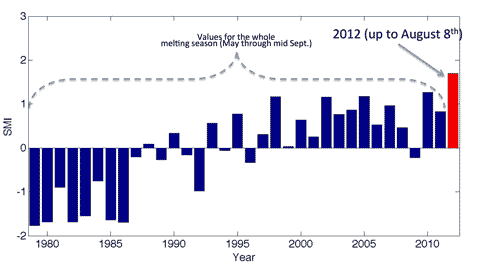
“With more yet to come in August, this year’s overall melting will fall way above the old records. That’s a goliath year – the greatest melt since satellite recording began in 1979.”

Tedesco and his team calculate the duration and extent of melt over the ice sheet, using satellite data to develop a ‘cumulative melting index’. The index is defined as the number of days when melting occurs multiplied by the total area subject to melting, and is a measure of how much melting has occurred in a season that normally runs from June to September. As the chart below demonstrates, by August 8th the melt was already well ahead of 2010.

TedescoSMI2012

So far this year Greenland has experienced extreme melt in virtually every corner of the ice sheet, and especially at high altitudes. When summer’s over, and the research teams ponder the data they’ve gathered on the ice, it seems pretty clear that there are going to be some interesting figures to consider, with consequences for everyone with beachfront property… Follow Tedesco’s work, and that of other teams working on Greenland on his Greenland Melting site.

Nick Smith: another fossil fuel fail

MP Nick Smith in a NZ Herald opinion piece this week uses the fracking debate to advance the cause of fossil fuel mining. He claims that fracking is important in the development of geothermal energy and then moves seamlessly to the notion that we are desperately in need of unconventional natural gas in order to save us from falling back on coal, which we will otherwise “inevitably burn”. In defending fracking he manages to nicely couple the fossil fuel natural gas with a renewable energy source, geothermal.

It’s not my purpose to argue here about fracking as a technology. What is dismaying about Smith’s article is the complacency with which he advances the cause of natural gas. Writing enthusiastically of the huge unconventional shale gas resources in the US, he claims gas emits one-third the greenhouse gas emissions of coal. I know its emissions are lower, but it was news to me that they were as low as that. I could find no source to substantiate that figure. A little over half is the best figure I have been able to locate, and there are big questions about methane leakage in the fracking process. However let that pass. The real issue is the unrestrained pursuit of unconventional fossil fuels, which as James Hansen has reminded us often enough will mean game over for the climate.

Continue reading “Nick Smith: another fossil fuel fail”

NZ ETS, you are the weakest (international) link

Simon Johnson (Mr February) argues that the New Zealand Emissions Trading Scheme (NZETS) is “the weakest link” due to its high exposure to the international carbon market. The strong “international linkage” is the other side of the coin of the uncapped design of the NZETS. Both features reinforce just how ineffective the NZETS is in providing an incentive to reduce greenhouse gas emissions.

Who remembers the The Weakest Link? The quiz show with Anne Robinson the disciplinarian female host with the popular catchphrase “You are the weakest link. Goodbye!” Yes that’s today’s bonkers metaphor for another post on the NZETS. In addition to the observation that I would love to say “Goodbye!” to the ETS, there really is a relevant connection to the economics literature.

“Linking” of emissions trading schemes means that units from one ETS can be imported and surrendered by emitters regulated by a different ETS. There are papers and blog posts about international linkage. The key economic benefit claimed for linking two or more ETS, assuming that they are otherwise sensibly designed, is that the lowest-cost ways of reducing emissions within the linked schemes become available (via emissions trading) to the emitters of the linked schemes.

Continue reading “NZ ETS, you are the weakest (international) link”