
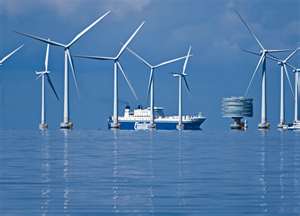
Offshore wind: a huge resource

Two wind energy items arrived in my inbox in close proximity recently. One was from the NZ Wind Energy Association (NZWEA) congratulating Meridian Energy on turning the first sod at Mill Creek wind farm in the Ohariu Valley north-west of Wellington. It’s a 60 megawatt farm of 26 turbines. The project will cost $169 million and is expected to be commissioned by mid-2014. It will increase NZ’s installed wind capacity from 623 megawatts to 683 megawatts.

NZWEA’s chief executive made appropriate remarks to accompany the announcement, reiterating the expectation that at least 20% of NZ’s electricity will be generated from wind by 2030 and noting the technology advances in harnessing wind which is now one of the lowest cost options for new generation in New Zealand.

It’s good to see the steady progress in the development of wind energy in NZ, although it seems to arouse little excitement in Government circles who reserve most of their interest for further  fossil fuel development. And a report in Saturday’s NZ Herald was a sobering reminder that the $7 billion invested in the oil and gas sector over the past five years puts it far ahead of any other local sector when it comes to investment in new productive capacity. NZ is hardly on the brink of transition from fossil fuels, hardly, it seems, even interested in the possibility while there’s money to be made from exploiting them.

Continue reading “Offshore wind: a huge resource”

Why Arctic sea ice shouldn’t leave anyone cold

In this guest post Neven Acropolis, the man behind the excellent Arctic Sea Ice blog, looks at the reasons why we need to pay attention to the rapid loss of sea ice in the Arctic Ocean.

Arctic sea ice became a recurrent feature on planet Earth around 47 million years ago. Since the start of the current ice age, about 2.5 million years ago, the Arctic Ocean has been completely covered with sea ice. Only during interglacials, like the one we are in now, does some of the sea ice melt during summer, when the top of the planet is oriented a bit more towards the Sun and receives large amounts of sunlight for several summer months. Even then, when winter starts, the ice-free portion of the Arctic Ocean freezes over again with a new layer of sea ice.

Since the dawn of human civilisation, 5000 to 8000 years ago, this annual ebb and flow of melting and freezing Arctic sea ice has been more or less consistent. There were periods when more ice melted during summer, and periods when less melted. However, a radical shift has occurred in recent times.

1 kinnard2011

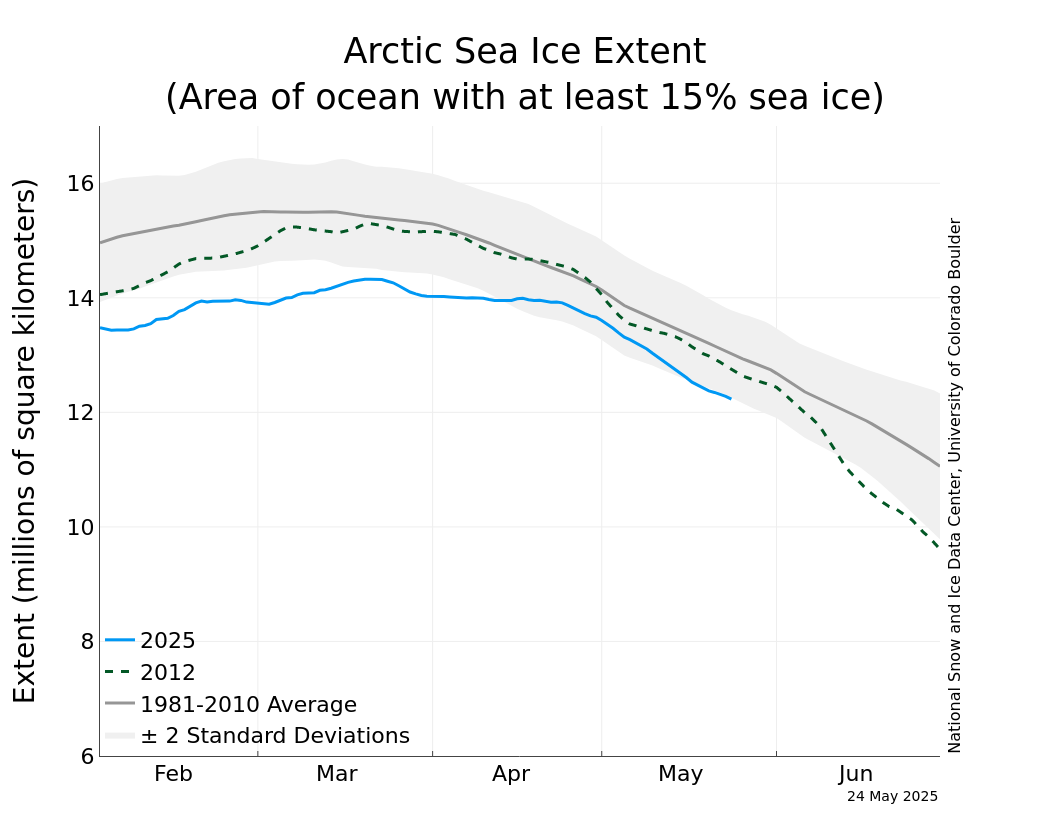
Ever since satellites allowed a detailed view of the Arctic and its ice, a pronounced decrease in summer sea ice cover has been observed (with this year setting a new record low). When the IPCC released its Fourth Assessment Report in 2007, it was generally thought that the Arctic could become ice-free somewhere near the end of this century. But changes in the Arctic have progressed at such speed that most experts now think 2030 might see an ice-free Arctic for the first time. Some say it could even happen this decade.

2 albedofeedbackWhat makes this event significant, is the role Arctic sea ice plays as a reflector of solar energy. Ice is white and therefore reflects a large part of incoming sunlight back out to space. But where there is no ice, dark ocean water absorbs most of the sunlight and thus heats up. The less ice there is, the more the water heats up, melting more ice. This feedback has all kinds of consequences for the Arctic region.
Continue reading “Why Arctic sea ice shouldn’t leave anyone cold”

A change is gonna come: no Arctic sea ice and our planet with a different climate

The crunch is coming. Before the end of this month, or very soon after, the Arctic sea ice will set a new record summer minimum for area and extent, by any measure. The only question remaining is by how much 2007’s record will be beaten. For the rest of the world, those of us who aren’t habitually glued to the Arctic Sea Ice Blog (where Neven’s counting the dominoes as they fall — one, two, three, four, five, six so far), or who aren’t checking the wonderful images from space that NASA assembles into an Arctic mosaic, or in the Greenpeace team hanging on to a Russian oil drilling rig, we have a simple lesson to learn. The climate of the northern hemisphere has changed, and with it the climate of the planet. And we have precious little idea of how that change is going to affect all of our futures.

Continue reading “A change is gonna come: no Arctic sea ice and our planet with a different climate”

Ice, Mice and Men

Geoff Simmons and Gareth Morgan, with help from John McCrystal, have produced a book which one hopes will be read by many New Zealanders.  Ice, Mice and Men: The Issues Facing our Far South not only carries illuminating scientific information about the islands and seas to our south and the Antarctic continent beyond them, but it communicates it in a relaxed and engaging style which should ensure a wide general readership. The more people understand what is happening in this vital region the better, and it’s easy to see this book adding to their number.

The opening section explains why the region is important, breaking it into three zones: first, the subantarctic islands, “liferafts” of the Southern Ocean; second, the Southern Ocean itself, home to the Antarctic Circumpolar Current (ACC) and “the engine room of the global ocean and the world’s climate”; third, Antarctica, including the sea ice that surrounds it which helps drive the marine food chain and affects the transport of nutrients essential for marine life around the world. The section provides a detailed account of the function of the three zones not just in relation to each other but in crucial relation to the globe as a whole.

Continue reading “Ice, Mice and Men”

The Aviator: new book now in flight

At last it can be revealed — the project that’s been swallowing most of my writing time over the last year. The Aviator is a work of speculative fiction ((Which I have sometimes described as a science fiction adventure comedy satire, or, via a tweet of Margaret Atwood’s, cli-fi.)), the first in a series set in The Burning World, and it’s my first foray into extended fiction — in which a plot idea borrowed from a bloke called Swift is wrapped around a dystopian vision of a climate-changed near future, all garnished with tales of strange people with even stranger ideas. This is how the great NZ comics artist Dylan Horrocks, who provided the book’s magnificent cover, describes it:

The Aviator is a light-hearted journey (by state-of-the-art airship) around a world transformed by climate change and subsequent political collapse. Rock God Evangelists, super-rich survivalists, back-to-nature primitivists, heavily armed luddites, goats with the secret of eternal youth, and a horny artificial intelligence with a taste for bluegrass and classic Hollywood films; The Aviator is a Gulliver-esque romp through a future we hope won’t come to pass.

I’m grateful to Mike Mann (yes, that one) for a generous note of approbation, and to sci-fi author ((And regular HT reader.)) Sonny Whitelaw for describing it as “a brilliant and wickedly satirical romp.” The first extended review — by my fellow sciblogger Ken Perrott of Open Parachute — has just been published, and provides an interesting and very positive take on what I’ve been up to.

The Aviator is currently available via Amazon for Kindle readers, and as an epub for other devices. You can download a free sample of the book — roughly 10% of the 100,000 word total — at Amazon. Editions for sale via Apple’s iBooks, Barnes & Noble and Kobo are in the works, and a paperback edition will be available in September. All digital editions are DRM free. When the publishing process is done and dusted, and I’ve stopped jumping through promotional hoops, I’ll be starting on book two. I have lots of ideas I want to explore from the vantage point of Thunderbird (the airship), if she’ll let me.

Buy now: