[youtube]-MZwMpQoqVM[/youtube]
Greenpeace have mastered the art of cool marketing, or marketing the need for cooling, or for loosening up a little, as Rhys Darby demonstrates… Sign on? You know it makes sense… 😉
Global warming and the future of New Zealand

[youtube]-MZwMpQoqVM[/youtube]
Greenpeace have mastered the art of cool marketing, or marketing the need for cooling, or for loosening up a little, as Rhys Darby demonstrates… Sign on? You know it makes sense… 😉
 An attendee at Nick Smith’s and Tim Groser’s public “consultation†at Hamilton last week was distinctly unimpressed. He said so in a column given a prominent position in Tuesday’s Waikato Times.Â
Rob Love expostulated that this was no consultation. Tedious introductions were followed by a long PowerPoint presentation by Environment Minister Dr Nick Smith. Finally, the Associate Minister Tim Groser “shared his observations on the blindingly obvious, while promoting the notion he is engaged heroically in the hardest negotiation ever undertaken.†There was little time left for discussion.
This article was first published in The Press on July 16. It’s a less technical version of my thoughts on where the government should pitch New Zealand’s emissions targets.
Climate change minister Nick Smith began his 2020 emissions target meeting in Christchurch last week by quoting Professor Ross Garnaut, the man who laid the foundations for Australia’s climate policy:
“Climate change is a diabolical policy problem. It is harder than any other issue of high importance that has come before our polity in living memoryâ€.
Garnaut was right. Global warming is certainly a big problem — there are none bigger — and there are three factors that make it so difficult to deal with. For a start, it’s a truly global problem. A solution is in no one country’s hands — it requires all the nations of the earth to work together, in itself a heroic challenge. Secondly, we have to act now to prevent the worst effects, even though we won’t see the benefit for decades. If we wait for climate change to bite, it will already be too late to stop terrible damage. And if that weren’t hard enough, we also have to make a fundamental change in the way we fuel our economies, ending our reliance on oil, coal and gas. The Devil’s own problem, indeed.
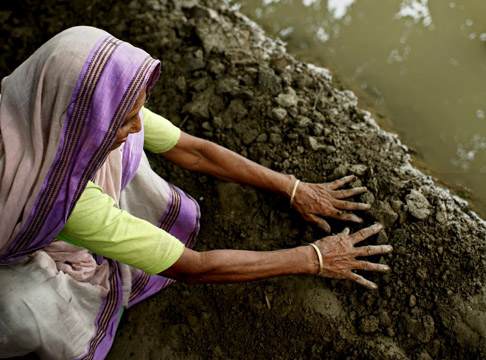 The Oxfam briefing paper Suffering the Science which figured in a recent post discussing TV3 is well worth attention in its own right. It is very much in tandem with the Copenhagen Synthesis Report which has been covered in a series of posts on Hot Topic. The foreword is provided by Professor Diana Liverman who was a co-author of the Synthesis Report. She comments that the Oxfam study adds powerful human stories to our understanding of climate risks and vulnerabilities.
What immediately stands out from the paper is that climate change is already having serious effects on the lives of poor people, especially in the tropics, and has been doing so for some time. The paper observes with some asperity that the nations that made themselves wealthy by burning fossil fuels are largely those that will, initially, suffer least from the effects of climate shift. Rich countries in temperate zones are buffered by their wealth and less drastic effects from rising temperatures. In other places climate change is hitting now and hitting hard.
When the full seriousness of climate change began to dawn on me I read some books directly on the subject. The first was Elizabeth Kolbert’s Field Notes From a Catastrophe: A Frontline Report on Climate Change which had just been published. I’ve reread it for this review. It’s an admirable work. I was impressed at how up to the mark it still is, three years on from publication. It remains a book which one could confidently recommend to anyone wanting to become quickly familiar with the issues. The writing is of the highest order of journalism, an intelligent mixture of relaxed narrative and clear, succinct summations.
Kolbert conveys the reality of global warming by recounting visits she was able to make to a variety of places and people. Not a large number, but each one significant, and Kolbert well able to show why. Her clear grasp of the basic science provides a thread through the experiences and meetings she describes. The Arctic figures strongly. She spent time with a geophysicist and permafrost expert in Alaska. The evidence of melting permafrost is unambiguous, and not affected by weather variations as air temperature is. In Greenland Kolbert stayed for a time at Swiss Camp, not far from the Jakobshavn glacier. Scientists have worked there over many summers to try and get a handle on what is happening to the Greenland ice. The Jakobshavn in 1992 flowed at 3.5 miles per year; by 2003 it had increased to 7.8 miles per year. The Arctic section of the book ended in Iceland at a scientific symposium in 2000, where it was already clear that whatever uncertainties there were about the effects of global warming there was no questioning at all of the relationship between carbon dioxide and rising temperatures.
From the Arctic Kolbert moves to butterflies, mosquitos, toads and other species showing evidence of species migration under the influence of global warming. She meets and speaks with individuals studying in these fields. The extinction risk from global warming is significant even for species with the capacity for mobility, and high for those more tethered to their environment. The prospect of everything changing its distribution and new biological communities needing to be formed carries unknown consequences for the services of our natural ecosystems.
Moving on to the human response to climate change Kolbert frames her treatment with reminders of how devastating drought has proved to human civilisation in the past. Those droughts reflected the climate’s innate variability, but the climate shifts predicted for this century are attributable to forces whose causes we know and whose magnitude we will determine. At this point she visits James Hansen and the Goddard Institute of Space Studies, the NASA outpost he directs. She provides a lucid account of how climate models work and the forcings they focus on.
The Netherlands provides a brief case study of how a country under threat from flooding is preparing to adapt to what lies ahead and the context for a discussion of what constitutes dangerous anthropogenic interference in the climate system. Although when Kolbert was writing her book policy studies were often taking 500 parts per million of CO2 as the threshold she points to many climate scientists then considering 450 ppm as a more objective estimate of danger, with some arguing that the threshold should be 400 ppm or lower. The Vostok core from Antarctica shows that the present level of CO2 in the atmosphere is unprecedented in recent geological history. She remarks that the last time CO2 levels are believed to have been comparable with today’s level was three and a half million years ago, during the mid-Pliocene warm period.
The fearful prospect of business as usual led Robert Socolow to think about how CO2 emissions could be stabilized. Kolbert visited him on her return from the Netherlands to discuss the now famous stabilization wedges that he and Princeton colleague Stephen Pacala proposed as substitutes for CO2 emitting processes. She records his comments that the issue is similar to some in the past where something looked extremely difficult, and not worth it, and then people changed their minds. Slavery was one such: “Something happened and all of a sudden it was wrong and we didn’t do it any more.” His answer to questions about practicality: “Whether it’s practical or not depends on how much we give a damn.”
It’s hard to believe the Bush administration gave a damn. Kolbert’s interview with Paula Dobriansky, the Under Secretary charged with the unenviable task of explaining the Bush administration’s position on global warming, is a classic. Asked how the US justified its position on Kyoto to its allies: “Basically and fundamentally we have a common goal and objective, but we are pursuing different approaches.” Three times in response to three different probing questions she repeated the mantra: “We act, we learn, we act again.” John McCain characterised Bush’s position to Kolbert as MIA (missing in action).
In a 2006 afterword for a further edition of the book Kolbert notes that continuing new studies were pointing to the fact that the world is changing more quickly and dramatically than anticipated. She highlights melting Arctic sea ice, ocean acidification, increases in the rate of CO2 rise in the atmosphere, increased ice loss from Greenland, and evidence of Antarctic ice loss. It’s all depressingly familiar still. What she couldn’t point to in 2006 were changes in US political will. They now appear to have happened, we must hope profoundly enough to soften the verdict of her final sentence: It may seem impossible to imagine that a technologically advanced society could choose, in essence, to destroy itself, but that is what we are now in the process of doing.
Bad Behavior has blocked 4303 access attempts in the last 7 days.