 The desperation that poorer countries are feeling over climate change was dramatically displayed at Barcelona this week when the African bloc walked out of the official negotiations towards a Copenhagen agreement. Their complaint, reports the Guardian, was that the rich nations’ carbon cuts were far too small to avoid catastrophic climate change. The demand is that the rich countries adopt the science-backed target of a 40% overall cut on emissions on 1990 levels. So far, rich countries have pledged an aggregate of less than 10%. The US, the world’s second biggest polluter, has pledged to cut around 4% on 1990 levels, or 17% on 2005 levels.
Muddled economics ignore reality
 “The analysis of the NZIER in their latest report is muddled and superficial” Exactly. I was relieved to see this response from the Parliamentary Commissioner for the Environment, Dr. Jan Wright, to the report the NZ Institute for Economic Research has just published on sustainable development priorities.
The report’s findings on climate change are a challenge to the imagination. It provides some criteria for measuring priorities which lead to the conclusion that “the main focus of climate change policy in recent years, emissions reduction, is not the most crucial priority for environmental policy.”
Now Or Never

“It is all too possible that we will fail to achieve sustainability, and that the blind watchmaker will once again…reset the balance of a severely diminished living Earth.” That’s the possibility that Tim Flannery hopes we can yet avoid. He makes the statement early in his essay Now Or Never: Why We Must Act Now to End Climate Change and Create a Sustainable Future, in the course of setting out his view of Earth as a living whole, where he follows James Lovelock’s Gaia hypothesis. The evolutionary process has arrived at a system in which humanity can contribute intelligence and self-awareness to the functioning of Earth – or set the process at naught and turn back the evolutionary clock.
Flannery’s earlier book The Weather Makers, reviewed here, was his major contribution to advancing public awareness of climate change. Now or Never echoes and updates the urgency of the earlier book. His regard for Lovelock’s thinking remains high, in terms both of the Gaia metaphor and of the extremity to which we have come, but he resists Lovelock’s conclusion that the damage already done is too great for amendment.
After his initia Gaia musings Flannery has an illuminating chapter on how we are shuffling matter among Earth’s three great organs – crust, air and water – and thereby creating an imbalance. He writes of Earth’s contrast with the planets without life, such as Mars and Venus, where the great bulk of the atmosphere is made up of CO2. On our living planet the difference is that over aeons enormous quantities of carbon have been drawn into Earth’s crust in the form of coal, oil, natural gas and limestone. Our bringing to the surface and burning these stored sources, combined with the destruction of forests and the degradation of soils, has created an imbalance whereby the concentration of CO2 in the atmosphere has reached a level not seen for 55 million years.
The impacts are already alarming. Flannery confesses to find it increasingly difficult over the past two years to read the scientific findings on climate change without despairing. Most dispiriting are the changes occurring in the Arctic, which render hopelessly inadequate much of the human response to the crisis so far. Flannery has an excursion into the possibility of oceanic death, concluding with the fearful vision of Peter Ward in Under a Green Sky. He turns then to the work of James Hansen and colleagues in their 2008 paper and concludes that humanity is now between a tipping point (where greenhouse gas concentration reaches a level sufficient to cause catastrophic climate change) and the point of no return (when that concentration has been in place sufficiently long to give rise to an irreversible process). We still have a few years before we reach the point of no return, but there is not a second to waste. Energy use must change drastically and we must also draw CO2 out of the air. Otherwise we enter Lovelock’s new dark age.
Turning to solutions Flannery spends time on clean coal technology, not because he is enamoured of it but because the world, and China in particular, has gone so far down the road of using coal as an energy source that he sees little choice but to pursue a solution that involves coal. Not instead of renewables, but along with them. Resignation rather than enthusiasm marks his treatment of the subject.
On renewables he notes the US government clean energy initiatives and the development of trading schemes to put a price on carbon, adding that regulation will also have to be part of the strategy. Not having the space to review all the means of generating electricity without carbon emissions, he selects one hopeful example from plans in Denmark to ally electric cars to wind energy which is currently under-utilised at night. He sees it as a sign that wind energy can compete directly with big oil.
CO2 must be drawn down from the atmosphere. High-tech methods remain on the drawing boards for now, but tropical forests are “prodigious engines of atmospheric sanitation”, and Flannery surveys ways of supporting tropical reforestation, preferably under local management. Funding reforestation is in all our interests, and is also a way of repaying a debt we owe to the poor who are disproprtionately affected by the global warming we have caused. Flannery is an advocate of charcoal made by pyrolysis being ploughed back into the soil as a form of carbon sequestration and soil improvement. Vigorously pursued on a global scale it could pull 5 percent of global CO2 per year.
He takes a look at ways in which farming management processes may enhance soil carbon significantly, mentioning a number of new practices worth pursuing, including holistic management and nitrification inhibitors. Farm-based ecological efficiency is described in Polyface Farm in Virginia, a mixed-farming undertaking which has integrated a wide variety of plants and animals into productive and sustainable enterprise.
Before concluding Flannery acknowledges that desperate measures may be called for to avert disastrous melting of the Greenland ice cap in coming years, and believes that a measured dose of sulfur to the stratosphere to cause global dimming may yet be something we have to consider “if all else fails”.
“If we are successful in finding a sustainable way of living in the twenty-first century…” It’s a much bigger “if” in the author’s mind than he or any of us would wish, but there’s no escaping the reality. Gaia has brought us to a unique position and role on planet Earth. That’s the philosophical understanding from which Flannery operates, and he warns that if we don’t that exercise that role responsibly and maturely we will bring disaster on ourselves. The carbon we have freed, “like a malign genie, threatens the entire world.”
The book includes a number of interesting invited responses to the essay. Among them Bill McKibben endorses the seriousness of the situation and urges 350.org activism as a way of acting. Richard Branson imagines a world where the best scientists collaborate with the best entrepeneurs and finds ground for optimism. Peter Singer welcomes Flannery’s impact on public and political awareness and agrees that there is no time to waste, but takes issue over the implications of eating beef. Gwynne Dyer notes that whether we talk of human beings becoming the consciousness of Gaia, or just see us as the same old self-serving species we always were, we are taking control of the planet’s climate, and we may need stop-gap geoengineering measures to win extra time to get emissions down before we hit runaway warming.
Tim Flannery’s informed intelligence, ranging thoughtfulness and humanity is as apparent as ever in this essay. Short and accessible, its urgent message could not be plainer. One hopes its readers include any policy makers who still need a wake-up call as to the reality of what we are doing to the planet.
Climate Change in Africa
We need to have it spelt out. Africa will be hit hard as the effects of climate change fall disproportionately on the world’s poorest people and countries. Camilla Toulmin’s book Climate Change in Africa surveys those effects and focuses on the adaptation measures needed to lessen the impact of what lies ahead. She endorses the notion that rich countries’ funding for adaptation in the least developed countries is not aid but compensation owing for the danger caused by those responsible for emissions. She also states early on that the choice of priorities is whether we will put our efforts into preserving the way of life of the rich, or addressing the urgent needs of the poor. But the book doesn’t dwell on ethics. Most of it is nuts and bolts analysis of what African countries will need to do to develop the resilience required to best manage the threats posed by global warming.
Toulmin acknowledges that there is some continuity between the development tasks already confronting African countries and the additional measures needed to cope with climate change. That doesn’t make the extra effort any less demanding. Indeed it is harder because it is required from communities already stretched for resources.
The effects of climate change are likely to vary greatly in the different regions of Africa. Water is a clear example. Some regions will suffer major shortfalls in water supply while others risk increased floods. Toulmin’s division of water into two categories – green (rainfall going into the soil and supporting plant life) and blue (rivers and aquifers) – provides a useful way of thinking about its availability. Her wide-ranging consideration of adaptation measures includes the more effective use of available water by investment in micro-level water supplies, and the need for agreement between countries on sharing large river basins.
In discussing how food production is likely to be affected Toulmin incidentally provides an interesting sketch of the great variety of food and farming systems in Africa. She points to the adaptability of African farmers over many generations, including the adoption of new crops and livestock. An example is the way simple improved soil and water conservation activities on the central plateau of Burkina Faso over the past 20 years have resulted in remarkable improvements in crop yields, tree cover, and rising groundwater tables, turning around the life of a declining area. But the vulnerability of farming to climate change is serious and the need to build more resilient systems is pressing.
Forests figure largely in much African life. The continent hosts 16% of the world’s forests, from the lowland forests of the Congo basin which is the second largest expanse of of rainforest in the world after the Amazon, to the forest land in the extensive drylands of the savannah and Sahel which cover approximately 40% of the continent. Deforestation is a serious issue and the point at which Africa’s contribution to atmospheric CO2 becomes significant. In the course of her discussion Toulmin makes a case for forest dwellers to have more say in the management of forests, arguing that their involvement in long-term management often has better results than that of the state alone. The importance of mechanisms post-Kyoto to compensate countries for avoided deforestation is discussed at some length, with acknowledgement of the complexities involved.
Africa, like the rest of the world, is experiencing a growth in urbanisation, often in the form of fragile informal squatter settlements. Toulmin lists many of the risks to cities from climate change, including heat waves, flooding, pollution and sea level rise. A mere half metre rise will drastically affect Alexandria, and settlements on the west coast and elsewhere are also vulnerable. She stresses the need for adaptation plans in the continent’s cities, while acknowledging that their responsibilities far outweigh their resources. Durban is one of the few cities to take adaptation seriously, and its measures are described.
Climate change may increase the likelihood of conflict in Africa, as basic human security is put at risk. Toulmin is cautious of ascribing particular conflicts such as Darfur to climate change, seeing the causes as complex, but she recognises that population movement driven by climate change may lead to land ownership disputes. The size of military budgets shows that lack of money is not the main problem in addressing security and she uges that the security agenda be reframed to focus on technical, institutional and economic measures to build resilience for the changes ahead.
Toulmin fears that in spite of all its problems Africa will be marginalised in the global carbon economy. It is hard for the countries of the continent to speak with one voice given their diverse set of interests and needs and consequently all too easy to leave them on the edge of the big global negotiations. Nor are the African poor as well represented by their governments as they should be, making it doubly difficult for their voices to be heard where global decisions are made.
This short but painstaking book packs in a good deal of patient explanation over a very wide range of issues. Sometimes one wonders whether there is any realistic way through the thicket of concerns about what climate change means for many African populations, particularly the poorest among them. But Toulmin maintains a steady focus on the policies required and how they can best be implemented. Such careful attention hopefully improves the chances that African peoples will receive some of the assistance they deserve in coping with what climate change threatens.
Afterword:
Shortly after writing this review I found myself watching a BBC programme about climate change refugees in Bangladesh who are thronging into the already overcrowded city of Dhaka. A different country, but horrifying evidence that the effects of global warming are already having a profound impact on the poor. Floods, storms and inundation from the sea are literally sweeping homes and livelihoods away. Some adaptation measures are being worked out in some villages, but others have no choice but to leave and live in the slums of the city, where again flooding is endemic and accompanying health problems overwhelming. The programme was a startling reminder that the measured words of the book I had just read were about real human lives and predicaments. These people bear little or no responsibility for global warming. It will be terrible dereliction if the developed world does not lend strong support to the adaptation effort which such countries must now attempt. On the mitigation front the urgency is made only more overwhelming by these early signs of what climate change is capable of doing to human society.
…Some fish, some barrel
 I’m afraid he’s at it again. Wishart, that is. It seems he can’t stop himself from reading Hot Topic and then posting his reactions. In his latest excursion, he reads a comment of mine, and then feels the need to once again demonstrate the depth of his understanding. He begins thus:
Can you believe the chutzpah? The thing that gets me about climate Chicken Littles is the way they repeat bogus claims ad nauseum as if true… this comment from Gareth Renowden at Hot Topic tonight illustrates ignorance on this point:
“In deep time, there have been periods when CO2 has been higher than now (how much higher is a matter of study), but lots of CO2 is inevitably associated with a warmer planet.”
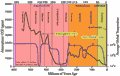
Invariably?? The blue line is temperature, the black line is CO2:
And he whips out the chart you see above (click on the thumbnail to be taken to the source). It features (without credit to source) on page 34 of Air Con. He continues:
I defy anyone, including Renowden, to find a pattern in the historical record that proves CO2 is “invariably” associated with a warmer planet. It will be especially hard for him as the ice cores all show CO2 rise lags temperature increase by several hundred years, not precedes it.
I didn’t have to try very hard to defy Wishart, because the “pattern” is well-established in the literature: