
The idea that a rise in global temperature of no more than two degrees above pre-industrial levels is a safe target for the world to aim for is widely accepted in political forums where the measures needed to stay within that range are considered. Not universally accepted though. The small island states and many others of the least developed countries already impacted by climate change are adamant that 1.5 degrees is the highest rise that should be considered safe.
Indeed one wonders what the reasoning of the more powerful nations has been in settling on the two degree target. When Mark Lynas trawled through predictions in scientific journals for his book Six Degrees (review here) he found plenty to disturb at two degrees, including possible desertification and abandonment of agriculture over millions of square kilometres in the US, an extremely hot and drought-ridden Mediterranean Europe, an ice-free Arctic ocean with implications difficult to measure, the bleaching and likely death of many coral reefs, major loss of food production in India, serious population displacement in Bangladesh.
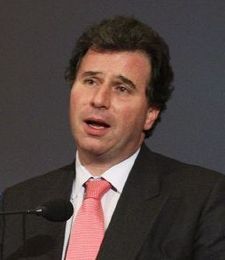
Now Chris Turney (pictured) and his University of Exeter colleague Richard Jones have reported their attempt to reconstruct the temperature during the Last Interglacial between 130,000 and 116,000 years ago. Their paper is published in the Journal of Quaternary Science. Turney explains its significance in his blog, where he writes:
“Temperatures appear to have been more than 5˚C warmer in polar regions while the tropics only warmed marginally; strikingly similar to recent trends. Not only this, but taken together, the world appears to have been some 1.5˚C warmer when compared to the 1961 to 1990 average. If we take into account the rise in temperature that has happened since industrialization, we find the Last Interglacial was around 1.9˚C warmer. Furthermore, this period also shows the warming in the Indian and Southern oceans took place before that of the northern hemisphere, suggesting these regions may cause further global warming beyond that directly forced by increasing greenhouse gas levels.”
It’s important to recognise what impacts that level of temperature rise brought. Turney points out that we know there was a dramatic decrease in polar sea ice coverage while large parts of the Antarctic and Greenland ice sheets melted. Critically, he says, the warmer temperatures appear to have helped global sea levels become some 6.6 to 9.4 metres higher than today, with a rate of rise of between 60 to 90 millimetres per decade, more than double that recently observed.
Let’s return to today’s “safe target” notion of no more than two degrees above pre-industrial levels. Here’s one of the key messages from the EU reference document explaining the scientific background for that target:
“Global mean temperature increases of up to 2°C (relative to pre-industrial levels) are likely to allow adaptation to climate change for many human systems at globally acceptable economic, social and environmental costs. However, the ability of many natural ecosystems to adapt to rapid climate change is limited and may be exceeded before a 2°C temperature increase is reached.”
If Turney and Jones’ estimation of the temperature in the Last Interglacial is correct it suggests that sea levels will rise significantly higher than anticipated. How a sea level rise six to nine metres higher than today could be adapted to “at globally acceptable economic, social and environmental costs” rather beggars the imagination.
So far as Turney is concerned, “The inevitable conclusion is emission targets will have to be lowered further still. Not a popular message.”
It has been apparent for some time that ice sheets are showing signs of less stability than was expected. It is not news that sea level rise this century looks likely to be higher than the IPCC estimates (a possibility recognised in the IPCC report itself). But what Turney and Jones add is evidence that the past may be offering us a specific guide as to what sea level rise we would need to prepare for if we allowed a two degree temperature rise.
Turney is a geologist whose interest is in researching the past, particularly in relation to climate. His excellent book Ice, Mud and Blood was reviewed on Hot Topic last year. He has continued to figure from time to time on the site because of his connection with the New Zealand firm Carbonscape. We noted his recognition last year by the Sunday Times as one of the modern-day heroes of science and technology.
He finishes his blog with these words:
“Crucially, the scientific and policy implications of the Last Interglacial demonstrate it pays to look back to yesteryear. As the great poet and playwright Thomas Eliot once wrote, ‘Time present and time past, are both perhaps present in time future, and time future contained in time past.’ Fingers crossed these words are heeded.”
Fingers crossed indeed. Against the seemingly unstoppable drive to exploit fossil fuels we need some signs of hope that society’s leaders are going to wake up to the dangers we are heading for. There are glimmers, as I pointed to in my post yesterday, perhaps even gleams if William Hague is representative, but a far wider section of our political and economic leadership needs to become fully acquainted with the lessons from the past.
Gareth adds (because he was going to blog this, but Bryan got his post in first)]: The period that Turney and Jones are considering — the last interglacial (LIG), better known (at least to me, though Turney’s blog provides other names) as the Eemian, is interesting because it provides an example of where we may be heading. During the LIG CO2 peaked at under 300 ppm, and sea levels were 6m to 9m higher than present, with rates of sea level rise of at least 6cm to 9cm per decade. The last time CO2 was at 300 ppm was before Dave Keeling started taking accurate measurements in the late 50s (it was about 312 ppm in 1958, and we’re nudging 390 ppm at present). In other words, the equilibrium response (that is, the long-term — century to millennial scale — response, when the oceans and ice sheets have had a chance to catch up) to the greenhouse gas levels more than 50 years ago is sea level at least 6 metres higher than now — and as Turney and Jones find, a global average temperature 1.9ºC above pre-industrial. The 2ºC “target” being bandied around as “achievable” (50% odds only) at 450 ppm is likely to be a mirage — it might hold true in the short term, but 450 ppm commits us to something well beyond the LIG/Eemian, when, as you will not need reminding, there were crocs and hippos in the Thames. When James Hansen was looking at long term targets, he selected 350 ppm as compatible with a planet with ice sheets at both poles. Turney and Jones synthesis of data on the Eemian suggests that if that’s our goal we need to be looking at 300 ppm — and a much bigger task. Over to Bill…
Turney, C. S. and Jones, R. T. (2010), Does the Agulhas Current amplify global temperatures during super-interglacials?. Journal of Quaternary Science, 25: 839–843. doi: 10.1002/jqs.1423
[Moody Blues]

 Two modestly hopeful signs from the political world struck me when reading today’s Guardian news. One was the opening of the climate change talks at Tainjin in China aimed at refining possible goals for the Cancun talks in November-December. The comment of Oxfam observer Kelly Dent attracted my attention. Oxfam is a careful watchdog of climate negotiations.