Wake of the flood (first reprise)

EOBangkok20111025

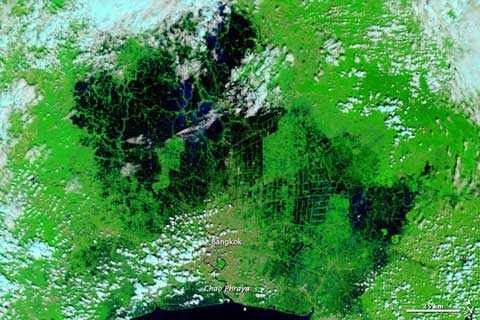
Thailand is experiencing its worst monsoon flooding for at least 50 years. The NASA Earth Observatory image above shows the waters piling up to the North of the capital Bangkok, which is already beginning to experience flooding (visit the EO page to see a comparison with earlier floods, and The Guardian for a striking set of flood pictures). The Thai government yesterday declared a five day weekend to allow the city’s inhabitants to make preparations. The intense monsoon season has also brought extensive flooding to Cambodia and northeastern India over the last couple of months, and destroyed a significant part of SE Asia’s rice crop. On the other side of the planet, heavy rain and flooding has been affecting Mexico, El Salvador, Costa Rica, Honduras, Guatemala, and Nicaragua. Jeff Masters reported that in the ten days up to October 20th, Huizucar in El Salvador received an astonishing 1.513 metres of rain.

At first glance, it looks like a continuation of the remarkable series of extreme weather events — especially heavy rainfall and flooding — that we’ve seen over the last few years. But apart from the human suffering and economic dislocation being experienced around the world, it appears there’s another interesting consequence of all this precipitation — it’s causing global sea level to fall.

Continue reading “Wake of the flood (first reprise)”

The Ecological Rift

Why do we continue with business as usual when we know that it is leading us to disastrous climate change? According to the authors of The Ecological Rift: Capitalism’s War on the Earth it is because our capitalist economic system is driven by forces which cannot stand back and weigh the consequences of their drive. The blind accumulation of private wealth at the expense of the environment has enormous momentum which the system is not geared to control.

The authors, John Bellamy Foster, Brett Clark and Richard York are all sociology professors. They write from the broadly Marxist standpoint exemplified by the Monthly Review magazine of which Foster is the current editor. As might be expected, their attack on capitalism is not limited to its environmental devastation but also takes in its exploitation of human labour for private profit. One of the interests of the book, for me with only a superficial acquaintance with Marx’s thought, was its explanation of the unity which Marx saw in nature and society and which western Marxism failed to sustain. The authors point, for example, to Marx’s interest in soil science and awareness of the nutrient depletion accompanying a more industrialised agriculture. Nature as well as human society needed to be protected from the capitalist juggernaut.

Continue reading “The Ecological Rift”

You’re (not) the BEST thing

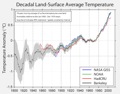
Set aside for one moment the fact that New Zealand has just (in every sense of that word) won the Rugby World Cup for the first time in a quarter of a century, and consider instead events in the world of temperature records. (Don’t worry, it won’t take long). A team led by Berkeley physicist Richard Muller — the Berkeley Earth Surface Temperature project (BEST) — has successfully reinvented the wheel, by demonstrating (once again) that the planet has been warming over the last 150 years. Tim Lambert at Deltoid explains the algorithm Muller employed:

  1. State that “reported global warming may be biased by poor station quality“.
  2. Collect funding from Charles G. Koch Charitable Foundation.
  3. Make the utterly predictable finding that warming is not a product of poor measurement.
  4. Brief reporters.

Michael Tobis at Planet 3.0 puts the affair in its proper context:

The science has not changed a whit – no serious scientist cares very much that the record has been confirmed yet again. Under ordinary circumstances this paper would have trouble getting published. This is not a red-letter day in scientific history. No new information is on the table. It’s posturing.

As for posturing, Brian Angliss at Scholars & Rogues points out that a certain US weather station quality control effort is under a little stress. One wonders if this might not spread to those who would wish to cast doubt on the NZ record?

[The Style Council]

The Climate Show #20: the boys are back (on Tuvalu)

[youtube]oiIk_3RU4XM[/youtube]

Battling against rural broadband that resembled digital molasses (or the bunker oil being pumped out of the Rena), Gareth returns to NZ and joins Glenn Williams and John Cook to discuss drought in Tuvalu, the El Niño Southern Oscillation (ENSO), floods and sea level falls, ocean cooling (that isn’t), solar towers of power and much, much more…

Watch The Climate Show on our Youtube channel, subscribe to the podcast via iTunes, listen to us via Stitcher on your smartphone or listen direct/download from the link below the fold…

Follow The Climate Show at The Climate Show web site, and on Facebook and Twitter.

Continue reading “The Climate Show #20: the boys are back (on Tuvalu)”

120% Pure Subsidy: Part 2

I have had some very good comments on my recent post, 120% Pure Subsidy, about the quantity of free emissions units that NZ Aluminium Smelters Limited (NZAS) has received under the NZ ETS in 2010. Enough good comments that they justify a second post on the subject.

Simon Terry of the Sustainability Council points out that we shouldn’t be surprised at the high level of free allocation of units to big emitters. Simon Terry documented this in June 2008, in the report Corporate Welfare Under the ETS, which looked at free allocation of units to eight energy intensive companies under the proposed NZ ETS.

Continue reading “120% Pure Subsidy: Part 2”