
Prat Watch #3: through the looking glass

Sunday morning laughs: over at his Climate Conversation Club, Richard “no warming in NZ” Treadgold fulminates about about the contents ((Interestingly, his horror is at the mundane reality of an author promising to put together a first draft of a summary for policymakers, which before publication will go through numerous drafts and which will be fought over line by line by the representatives of every government participating in the IPCC process, before being explicitly approved by them all.)) of a stolen email:

Appalling. It’s a free world, so even the “leaders” in climatology are entitled to express the opinion they like. But I draw attention to those who willingly follow these atrocious examples. Such people sabotage science, ransack reason and in the end destroy democracy. Though they imagine they do these things entirely for our own good, they must feel the heat of public opprobrium before they destroy us.

Change one word in that elegant little diatribe, and I would agree one hundred percent. The word? Climatology. Strike that through, and replace it with your word of choice for those would try to persuade us to do nothing.

It really is a looking-glass world on “the other side”: a world where the direction we know as up is called down, black appears to be white, and the laws of physics are puzzling Alice ((“When I use a word,” Humpty Dumpty said in a rather a scornful tone, “it means just what I choose it to mean — neither more nor less. Source.)).

Climate Change and Migration

It’s all too easy for wealthy America and Europe to treat climate-induced migration as a border security issue. Gregory White, Professor of Government at Smith College in Massachusetts, argues in his recent book Climate Change and Migration: Security and Borders in a Warming World that a security-minded response to the phenomenon is both inappropriate and unethical. It’s not a judgment the book rushes to; White provides ample and thoughtfully-presented material in its support.

The dynamics of globalisation have brought with them an increasing preoccupation with border security, particularly in the countries of the North Atlantic. Immigration is a hot electoral issue and the spectre of climate-induced migration adds to the already fraught subject. White writes of how easily deep fears can be aroused and of media-savvy politicians all to ready to play on them, along with the “media’s panic entrepreneurs”.

Continue reading “Climate Change and Migration”

McLean’s folly 2: the reckoning

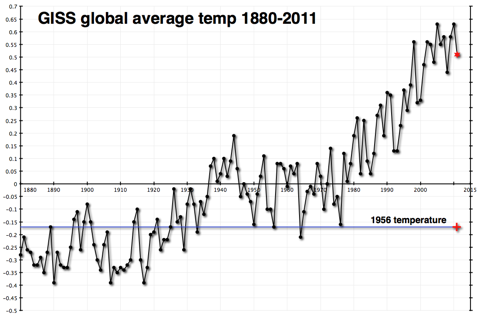
Ten months ago, Aussie “sceptic” John McLean predicted that 2011 would be “the coolest year since 1956”. I pointed out at the time that this was nonsense, and so it has proven to be. I’ve taken the GISS global temperature figure for Jan – Nov 2011 (+0.51ºC compared to the 1951-80 average) and added it to the graph I created to illustrate the full extent of McLean’s folly:
Maclean1956outcome

Last year was warmer than 1956 by a whopping 0.68ºC — about three standard deviations, in statistical terms — making McLean’s forecast an abysmal failure. Yes, 2011 was cooler than 2010 or 2009, but still one of the top ten warm years.

Continue reading “McLean’s folly 2: the reckoning”

Hansen: extreme heat the new normal

James Hansen and two fellow-authors have circulated a new paper which they will be submitting for publication, Perceptions of Climate Change: The New Climate Dice. I’m not qualified to comment on its scientific detail beyond reporting it as relatively accessible to the lay person, but there were elements in the discussion with which it concluded that I thought I could dwell on as a member of the general public with whom Hansen is always concerned to communicate.

The paper deals with the increasing frequency of extreme summer heat such as that experienced in the Moscow region in 2010 and Texas in 2011 and reaches the conclusion that we can say with a high degree of confidence that such events were a consequence of global warming. The base period of 1951 to 1980 is chosen against which to compare the changes of the last three decades. The chance of what would have been regarded as “hot” summers during that base period has increased in more recent decades and is now about 80%. Hansen comments that the climate dice are now loaded to the degree that a perceptive person (old enough to remember the climate of 1951 to 1980) should recognise the existence of climate change. I’m old enough. That base period coincides with the first half of my adult life.

Unfortunately my climate memory (or any memory for that matter) has deteriorated with age and I can’t honestly say that I recognise the change. But I can certainly see from the maps and graphs the paper provides that the second half of my adult years has been spent in a global climate significantly changed and continuing to change. It’s a sobering thought, bringing home the magnitude and rapidity of the alteration we have effected.

Continue reading “Hansen: extreme heat the new normal”

Signs of things to come: Salinger on Australian heatwaves

Climate change is happening now and Australia is in the firing line says Jim Salinger in this guest post. This article first appeared in the Dominion Post.

As I watch from my summer subtropical perch in Brisbane, Queensland, the somewhat unprecedented rains that deluged parts of Australia during the summer of 2010/11 have been replaced by sizzling heat waves this summer. These raise some pertinent lessons on climate and risk management for New Zealand. Firstly let’s look at some figures and ask the question of what are the climate mechanisms behind the heat waves.

For December 2011 the Bureau of Meteorology figures show that the highest temperatures of the year occurred in the third Australian heat wave of the year. This affected the Pilbara region in the north west of Western Australia. Multiple sites broke the previous Western Australian December record of 48.8ºC on December 26, 1986 with Roebourne recording 49.4ºC on December 21, Onslow Airport recording 49.2ºC on the 22nd and Learmonth 48.9ºC on the 23rd. Roebourne’s 49.4ºC was the highest temperature recorded in Australia since 1998.

This month incessant heat has struck the interior with daytime highs soaring to the mid forties. As I pen this there are a few more days of this heat wave left with temperatures averaging between 35ºC and 40ºC in central Australia. Places have been recording daily lows of 30ºC and daily highs of close to 45ºC. Mean temperatures have been running over 6ºC above average.

Continue reading “Signs of things to come: Salinger on Australian heatwaves”