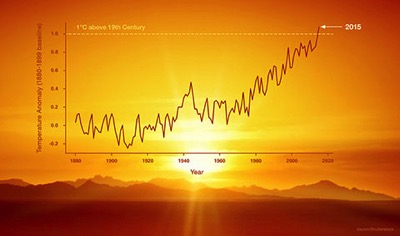
 2015 was the hottest year since records began in all of the major global temperature datasets, and by a huge margin. The world is now more than 1ºC warmer than pre-industrial temperatures — pushed there by rapidly rising levels of greenhouse gases in the atmosphere, and helped a little by the current very strong El Niño. And because El Niño’s major impacts on global temperatures happen as an event declines, we can expect 2016 to be even warmer.
Carbon Brief has an excellent analysis of the new record here. See also NASA and NOAA’s joint announcement, the NASA press release, and Hansen et al’s overview (pdf). Here’s the latter on the outlook for the rest of the decade:
We can also say with confidence, because of Earth’s energy imbalance (energy absorbed from sunlight exceeding heat radiated to space), that the present decade will be warmer than last decade. Already the first half of the present decade is almost 0.1°C warmer than last decade. Strong La Niñas commonly follow strong El Niños, so it is likely that 2017 and perhaps 2018 will be quite cool relative to 2015-2016, but the decade as a whole should be considerably warmer than the prior decade.
Kevin Trenberth provides an interesting overview at The Conversation, detailing some of the weather extremes delivered by the current El Niño, and notes:
What we have seen this past year will likely be routine in about 15 years, although regionally the details will vary considerably. Indeed, we have had a glimpse of the future under global warming.
You wouldn’t want to bet against it continuing… Continue reading “Too hot (and here comes the surge)”
 Climate change denier and Auckland University geographer Chris de Freitas seems to have fast access to the dialogue pages of the NZ Herald. His
  The IPCC released the summary for policymakers of its Special Report on Managing the Risks of Extreme Events and Disasters to Advance Climate Change Adaptation (SREX) in Kampala, Uganda, on Friday (
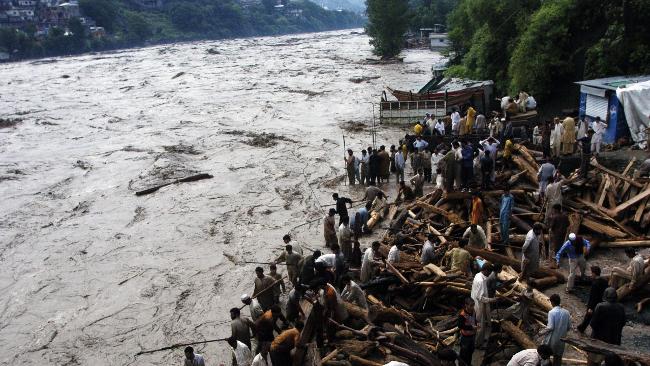 Al Gore didn’t hesitate to dwell on extreme weather events as evidence of the reality of climate change in his closing address for the 24-hour Climate Reality Project last week. There has certainly been no lack of them in the past year or so. Was he pushing the boundaries of the science? It wouldn’t worry me too much if he was because there’s plenty else in the scientific projections which is clearly under way, such as the melting polar ice or the acidification of the oceans. But Gore is a very intelligent and well-informed man and I don’t think he allowed himself to be carried away beyond the scientific mandate. Consider what is being said by some scientists right now.