Offshore energy for export

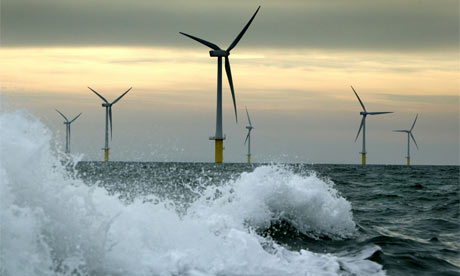
Ben McNeil’s scenario, in The Clean Industrial Revolution, of Australia as a future source of renewable energy exported to its Asian neighbours was of necessity somewhat speculative. However a major report published this week laid out, in very concrete terms, the possibility of the UK becoming a net exporter of renewable energy, not solar in this case, but garnered from the wind and waves of the sea.

The report of the Offshore Valuation Group was sponsored by the UK Department of Energy and Climate Change, the Scottish government, and a number of large companies. Tasked with estimating the value of the offshore renewable energy resource, the group’s findings exceeded their own  expectations.


“The next four decades of technological development could enable us to harness a practical resource ten times the size of today’s planned deployments. Integration with neighbouring electricity networks though a ‘super-grid’ could provide access to a single European electricity market, enabling the UK to sell renewable electricity across the continent.”

The report relied on technologies already either in use or in development: offshore wind with fixed or floating foundations, tidal stream, tidal range, and wave power. It also took into account competing uses of the sea and accessibility constraints.

The resource identified by the report is very large, capable of producing six times as much electricity as is currently used in the UK. The report recognised that electrification of transport and heating will add to demand by 2050, an increase of perhaps 75% on today’s demand. Harnessing 29% of the offshore resource by 2050 would be enough to turn the UK into a net exporter of renewable electricity at an estimated cost of £443 billion with an estimated annual revenue return of £62 billion. The annual production in 2050 would be equivalent to 1 billion barrels of oil. This is the average level of production experienced by the UK’s North Sea oil and gas over the four decades leading up to 2008.

The infrastructure deployment required is similar in scale to that of oil and gas in recent decades.  To deploy the capacity by 2050 would require an average build rate of 7.2GW per year (one thousand 7.5MW turbines per year), including repowering. Of this, 5.4GW would be fixed offshore wind, with the next largest share coming from floating wind. A big plus is that 145,000 jobs could be created in direct roles.

The current EU supergrid negotiations are of major importance to any export development and the report urges that the UK take a leadership role to ensure that the UK derives maximum value from its design and implementation. Government involvement would be essential in many aspects of the development, in cooperation with industry. One is finding ways to develop innovative financing mechanisms that can match the long term risk and reward profile of renewable energy investments. This could take the form of green energy bonds designed either for corporate investors such as pension funds or for individual investors, and should be designed to deliver finance at the required scale; for the 29% harnessing option an average annual investment of £11 billion will be required between 2010 and 2050.

Another role for government is setting a national ambition to become an exporter of offshore renewable electricity. This will provide industry with the confidence it needs to invest for the longer term, it will demonstrate a strong commitment to existing renewable energy and climate targets, and it will help to guide long term policy development on related issues such as energy markets, grid and supply chain development.

The conclusion:

“The UK is now most of the way through its first great offshore energy asset, our stock of hydrocarbon reserves. The central finding of this report is that our second offshore asset, of renewable energy, could be just as valuable. Britain’s extensive offshore experience could now unlock an energy flow that will never run out.”

We wait to see what the policy makers do with the report. Peter Madigan, Head of Offshore Renewables at RenewableUK, was in no doubt about what should happen:


“This is a hugely exciting piece of research which sets out compelling factual evidence of the huge potential of the UK’s offshore renewable energy resource. As an association we have long been saying that the North Sea will become the Saudi Arabia of wind energy, and today’s tonne of oil and employment comparisons amply bear this out. Just as 30 years  ago, the North Sea could be our ticket for economic growth. We are looking forward to the new Government putting in place the policy framework to make this happen.”

Cooling-gate! Easterbrook fakes his figures, hides the incline

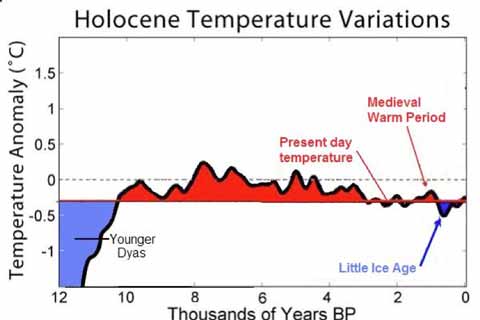
Don Easterbrook, the retired geology professor who predicted that the world was headed for decades of global cooling at the recent Heartland climate sceptic conference, appears to have crudely faked one of the key graphs in his presentation in order to reduce modern temperatures and make historical climate look warmer than justified. Looking through Easterbrook’s slides, it seems he has taken a graph of Holocene temperature variations prepared by Global Warming Art (used at Wikipedia), and altered it to fraudulently bolster his case.

Here’s Easterbrook’s graph (slide 9, ppt file available here):

Easterbrookholocene.009.jpg

When I saw that graphic, it struck me as strangely familiar. The typefaces and presentation are reminiscent of graphs prepared by Robert A Rohde for Global Warming Art. So I checked, and this is what I found:

Continue reading “Cooling-gate! Easterbrook fakes his figures, hides the incline”

Greasy Heart(land)

And so the party’s over, the tables in the ballroom at the Magnificent Mile Marriot Hotel in Chicago have been tidied up and the carpet vacuumed. The Monckton fan club have drifted away from their vigil in the shade of the trees on the sidewalk outside the lobby, and the speakers assembled from around the world have gone home — except for the ones still waiting in line outside Hot Doug’s for the duck fat fries and andouille special (Fridays & Saturdays only, well worth waiting for, I can assure you).

Luckily for us, however, Heartland are promising to make all the talks available on video, so we won’t have to miss any of the highlights. At the moment they only have the keynotes available, but there are quite a few Powerpoints available for download. I’ve been poking around in some of those…

Continue reading “Greasy Heart(land)”

The Clean Industrial Revolution

The Clean Industrial Revolution: Growing Australian Prosperity in a Greenhouse Age

The problem with cutting greenhouse gas emissions is that it will harm economic growth. Right? No, quite the opposite, says Ben McNeil in his book The Clean Industrial Revolution. It’s an age-old myth that doing good for the environment is bad for the economy. He’s addressing Australians, but what he has to say will arrest readers from many countries. It has certainly grabbed the attention of some prominent New Zealand businessmen who have presented every MP with a copy of the book and used it to back a call to the Prime Minister for a joint business/government task-force to focus attention on emerging clean technologies.

McNeil is a senior research fellow at the Climate Change Research Centre at the University of New South Wales. Besides a PhD in climate science he also holds a Master of Economics degree.  The two worlds are bridged in this energetic book.  Australia is very vulnerable to climate change through sea-level rise, rainfall changes, storms, and a decrease in food production. It is also highly carbon-intensive in its economy and its export industries will suffer as a consequence when the world starts to move heavily to reduce carbon emissions and impose carbon tariffs.

Such consequences can be pre-empted by a clean-energy revolution, one for which Australia is well-endowed. That hot arid interior is the potential source of vast quantities of high capacity solar power. The use of mirrors to concentrate sunlight so perfectly that the ultra-high temperatures convert water to steam is one way. Another, already under construction in north-west Victoria, uses mirrors to concentrate the sunlight on to high-performance photovoltaic panels. Solar power could replace the need for coal-fired power stations. A massive underground “hot rock” heat source can be tapped to create steam for power generation, a technique already being worked on by a number of companies at several sites throughout Australia. Wind power in the south could supply 20 percent of the country’s needs. Advanced biofuels that do not impact on food can be produced.  Biomass-fuelled electricity is already generated in some parts of rural Australia. Carbon capture and storage may hold some hope for the continuing use of coal, though not while coal companies put a miserly 0.3 percent of their production value into research, apparently believing that governments will do the work for them.

McNeil argues that Australia must take up a forefront position in the low-carbon economic future if it wants to remain prosperous. At the time of writing in 2009 he expected the emissions trading scheme to kick in, putting a price on carbon and pointing the economy towards investment in clean energy. This has been delayed, but even without it there is ample reason for the change of focus away from the carbon-intensive economy (carbon obesity he calls it).  The world will soon be crying out for clean energy technology.  Australia will continue to prosper in the future if it has used research and development to drive down the cost of renewable energy technologies, and investment to commercialise them and prepare them for export.

McNeil illustrates this with a striking imaginary scenario. A series of climate catastrophes hit the world in the 2020s. Global greenhouse gas sanctions quickly followed. Those nations with expanses of desert which had been working on the development of solar power became the energy superpowers of the 21st century. Australia led in the building of the Asia Pacific Electricity Grid following a breakthrough in transport efficiency for transmission cables discovered by Australian researchers. The grid connected Australian energy supply to its Asian neighbours.  The scenario is much more elaborated than this, but it all certainly sounded feasible.

Back to present reality. McNeil is adamant that there are solid employment opportunities in an economy focused on clean energy. More than offered by the present carbon intensive economy, and jobs which can’t be outsourced. Creating energy-efficient homes and buildings, for example, is a proven source of increased jobs. The European Commission suggests that energy efficiency creates three to four times the level of employment as an equivalent investment in a new coal-fired power station. Renewable energy requires two or three times more people for operation than an equivalent coal-based energy project. A comparison between Denmark’s wind industry and New South Wales coal industry clinches that. A renewables manufacturing industry is feasible kept based in Australia by a strong domestic market.

McNeil provides a wealth of illustrative material from many countries and forward-looking firms. He instances General Electric’s ‘Ecoimagination’ programme launched in 2005, aimed at developing low-carbon solutions. The company reports that it has never had an initiative that generated better financial returns so quickly. Cloudy Germany is the world’s largest market for solar energy and German solar manufacturing companies produce over half the world’s solar panels. German companies are positioning themselves for the burgeoning global clean-tech market. Tiny Denmark manufactures over half the world’s wind turbines, obtains 20 percent of its electricity from wind and plans to increase that to 40 percent. McNeil notes dryly that contrary to some prophesies Danes are far richer than Australians by GDP per capita, while cutting their carbon intensity by over one-third in less than ten years.

Innovation needs science, and McNeil titles one of his chapters “How Science Must Save Us”. If Finland can produce Nokia, Australia also can help shape the world, not by raw military or economic might but by “the seeding of ideas in an interconnected world.” Education and research funding are crucial for the development of science and he discusses how they can be expanded. Scientists and engineers will not only develop new generation clean energy but also seek to understand and monitor the effects of climate change on the natural ecosystems of Australia with its immense variety of specially evolved plants and animals. They will also continue to seek the development of techniques for reducing methane emissions from livestock, which produce 10 percent of Australian greenhouse emissions.

McNeil knows first hand how serious the implications of climate change are.  The disease has been diagnosed but his attention in this book is on the cure. He matches the environmental imperative of emissions reduction with the economic benefit of entering wholeheartedly into a new, clean, low-carbon industrial revolution. Climate change poses a great risk to the Australian economy, and so does their over-reliance on fossil fuels. They need to embrace the change to clean energy. The costs of not doing so will far outweigh the cost of making the change.

One doesn’t need to be an Australian to be cheered by much that the book has to say and the detail with which it is illustrated.  But the final sentence has to be conditional:

“If Australia sets strong greenhouse gas emission targets and invests in unleashing clean-technology innovation,…”

Unfortunately it’s still a big if, not only for Australia.  But here’s the rest of the sentence:

“…not only will Australia help the world as it makes the transition towards a low-carbon development pathway to solve climate change, it will bring new prosperity and employment growth to a country desperately needing economic reform in its energy policy.”

Note: There’s a short relevant interview with Ben McNeil here on YouTube.

[Check out this book at: Fishpond, Amazon.com, Book Depository]

The thing we need to fix is ourselves

If you have 18 minutes to spare, spend them watching coral reef ecologist Jeremy Jackson’s recent TED talk about the ways in which humanity is wrecking the world’s oceans. Climate change is only one of the factors driving the massive changes being seen in the global ocean, and if we’re to have any hope of dealing with them we have to work out how, as Jackson puts it, we’re going to put Humpty together again. And we won’t manage that unless we fix ourselves first. Compelling, unsettling viewing.

Hat tip: Resilience Science.