
 Speaking recently at the Hay Festival in the UK, biographer Richard Holmes attacked the “dangerous” division between the arts and the sciences, warning that the split could be fatal in the face of global warming. Fifty years ago the British novelist and scientist C P Snow gave a famous lecture, The Two Cultures, which pointed to a breakdown of communication between the sciences and the humanities. I was a young man at the time and can remember thinking it characterised my position adequately enough. I was reasonably well informed in literature, history and theology but had very sparse knowledge when it came to the sciences. I’ve tried over the years since to get better acquainted with the major themes of science, but it’s pretty well in the nature of things that there’s no easy path from the humanities to the sciences. Traffic the other way flows much more readily and many scientists are very much at home in both worlds.
Category: Climate politics
You never give me your money
 Bill English’s first budget has disappointed many by ditching promised tax cuts, but pleased a few by reinstating a Green home insulation initiative. The Science Media Centre has a handy summary here. There’s $321 million of new money for R&D through a “Primary Growth Partnership” (details due on June 2), which goes some way to offset the loss of Labour’s “Fast Forward” fund, but no money for the promised climate change research centre (it was going to be a “virtual” centre, now it’s actually gone). Reaction in the science community was mixed, as the Science Media Centre documents. Professor Philippa Howden-Chapman, director of the He Kainga Oranga/Housing and Health Research Programme at the University of Otago, Wellington commented:
“I’m very pleased to see that there has been multi-partisan agreement about the importance of retrofitting insulation and install sustainable heating and that significant investment has been included in this Budget. There is going to be a ramp up over four years and by the end of that time it is estimated that over a quarter of uninsulated houses in New Zealand will be insulated.
“I think it’s important that the Government is requiring people to insulate their houses before they can access the subsidies for sustainable heaters. This makes physical and energy efficiency sense and is based on sound public health science. There has also been further attempts to increase the incentives for landlords to upgrade their properties, which is important for the 40% of householders that rent in the private sector.
Meanwhile, Prof Paul Callaghan at Victoria University was “disappointed” with the budget:
“If New Zealand is to turbocharge its way out of this recession, we have to develop new export businesses based on knowledge and innovation. What we need are significant new investments to build our innovation system. The 2009/10 budget has not addressed that issue.â€
However, in a fairly clear signal that the Emissions Trading Scheme is going to survive its select committee review, Nick Smith announced increased funding of $6.9 million for developing the Emissions Trading Scheme, “including international linkages”.
[Beatles (rare long version)]
The Minister Speaks
 The Minister Responsible for Climate Change Issues Nick Smith’s address to the recent NZ Climate Change Centre’s conference Managing the Unavoidable appeared to be the first comprehensive public statement he has made since assuming ministerial responsibility. I read it with interest and here offer comments on some of it.Â
Spinning wheel…
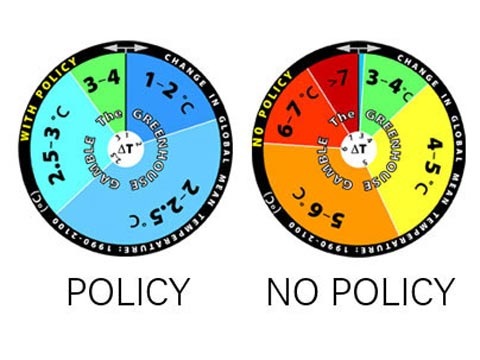
Feeling lucky? Spin these roulette wheels and see where the future lies: on the left, if the world takes decisive action to reduce emissions over the next 100 years, and on the right if we don’t. If we do: most likely an increase of 2 – 2.5ºC. If we don’t: most likely is 5 – 6ºC. Produced by the Joint Program on the Science and Policy of Global Change at MIT, the wheels are a novel way to express the uncertainties associated with projections of future climate and the way they interact with policy decisions. The message for policy makers is clear, according to study co-author Ronald Prinn:
“There’s no way the world can or should take these risks,” Prinn says. And the odds indicated by this modeling may actually understate the problem, because the model does not fully incorporate other positive feedbacks that can occur, for example, if increased temperatures caused a large-scale melting of permafrost in arctic regions and subsequent release of large quantities of methane, a very potent greenhouse gas. Including that feedback “is just going to make it worse,” Prinn says.
For a reminder of just what six degrees means, I recommend Mark Lynas. George Monbiot suggests that climate cranks will object to model projections like these:
Climate change deniers hate these models. Why, they say, should we base current policy on scenarios and computer programmes rather than observable facts? But that’s the trouble with the future: you can’t observe it. If you reject the world’s most sophisticated models as a means of forecasting likely climate trends, you must suggest an alternative. What do they propose? Gut feelings? Seaweed? Chicken entrails?
Tea leaves, obviously…
Friday omnibus #37b
To keep things ticking over while I’m in Auckland for the Royal Society’s inaugural Science Book Prize presentation here are a few items that have caught my eye over the last few days:
- The BBC reports on the end of the Catlin Arctic Ice Survey expedition, and prompts UK ice specialist Peter Wadhams to comment on the current state of the ice: “By 2013, we will see a much smaller area in summertime than now; and certainly by about 2020, I can imagine that only one area will remain in summer.” For this year, the Canadian Ice Service expects a summer minimum similar to the last two years.
- However much I moan about NZ’s big emitters arguing for delay and inaction (there was a particularly specious piece by Catherine Beard of the Greenhouse Policy Coalition in the Herald yesterday), our politicians have it easy compared to lawmakers in Washington. The Guardian reports that coal and oil interests lobbying against emissions reductions have spent US$45 million in the first three months of this year.
- Aficionados of conspiracy theories (Wishart, are you reading this?) will enjoy this review by Johann Hari of Voodoo Histories, a new book by David Aaronovitch: “[Aaronovitch] argues that we keep returning so obsessively to conspiracy theories because they are, paradoxically, reassuring. “Paranoiaâ€, he writes, “is actually the sticking plaster we fix to an altogether more painful woundâ€: the knowledge that life is chaotic and random and nobody is in charge.”
- New Scientist explores the deep roots of our understanding of the greenhouse effect by looking at the life of John Tyndall. Well worth a read.