
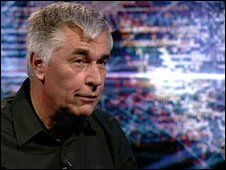
 Watching Stephen Sackur’s BBC Hard Talk interview with the retiring head of Greenpeace this week I was reminded of why I feel thankful that Greenpeace campaigns so hard and so persistently on climate change. The adversarial style of Hard Talk often grates, and it certainly did when Sackur accused Gerd Leipold of alarmism and even managed to manufacture the impression that Greenpeace claims that the whole Greenland ice sheet will have melted by 2030. Leipold refused to be sidetracked into defending the organisation against silly accusations, but held the line on the seriousness of the science and the need for political responses to be adequate to the science. Half measures won’t work.
Category: Climate politics
The Age Of Stupid – coming soon (or here now)
The NZ green carpet premiere of The Age Of Stupid — Franny Armstrong’s powerful drama documentary about global warming — is being held in Auckland on August 19th, in a solar-powered cinema tent. The blurb:
‘The Age Of Stupid’ is the new documentary from the Director of ‘McLibel’ and the Producer of the Oscar-winning ‘One Day In September’. This enormously ambitious drama-documentary-animation hybrid stars Oscar-nominated Pete Postlethwaite as an old man living in the devastated world of 2055, watching “archive” footage from 2008 and asking: why didn’t we stop climate change while we had the chance?
Bloody good question. Here’s a good recommendation: “The most powerful piece of cultural discourse on climate change ever produced.” — Mark Lynas, author of Six Degrees: Our Future on a Hotter Planet
Limited ticket sales at $30 from Oxfam and Greenpeace. Phone 0800 400 666. Public screenings begin at Hoyts Sylvia Park that same evening — tickets available direct from the cinema. An additional first night screening is being hosted by Grey Lynn 2030, the local transition town group, at Bridgeway Rialto, 122 Queen St, Northcote. 8.15pm Weds 19th Advance ticket sales only, $20 from Jayson at The Wine Vault, 453 Richmond Rd, Grey Lynn.
There will be showings at cinemas in other parts of New Zealand, see here for more details. If anyone else wants to arrange screenings, contact me to be put in touch with the organisers.
The price of a policy
 In the run up to last year’s election I devoted a lot of coverage to the ACT party’s descent into climate denial, and in particular to the outrageous statements of its leader Rodney Hide. It wasn’t clear to me at the time why Hide was ditching the party’s carefully constructed “Smart Green” positioning on environmental policy and spouting standard climate crank nonsense, but intriguing hints are now emerging thanks to excellent detective work at Canadian blog Deep Climate. Hide’s repositioning coincided with a major donation to ACT by Alan Gibbs, a wealthy NZ businessman best known here for his Aquada (a sportscar that thinks it’s a boat) and for his generous patronage of modern art. Gibbs, however, also plays a prominent role in climate crank organisations. He is on the “policy advisory board” of the International Climate Science Coalition (with such luminaries as Monckton, Bryan Leyland and Owen McShane), while his daughter Emma is listed as a director of the ICSC. In its election spending return to the Electoral Commission, ACT reveals that on April 9th 2008 Gibbs paid $100,000 into the party’s coffers. Within weeks, the party’s new climate denial line was being pushed to the press.
Some cuts are bigger than others
 Nick Smith and the government’s insistence that a sensible emissions target for 2020 is too expensive to even contemplate is coming under more pressure with the release today of a report [PDF] prepared by the Green Party, which they claim shows that big cuts are affordable. Announcing the release of the report, Greens climate spokesperson Jeanette Fitzsimons said [Scoop]:
“The Government says it can’t be done, but careful research shows it can be done. Environment Minister Nick Smith says it’s too hard and too expensive to set a responsible target, but the facts and the science say something different,” Ms Fitzsimons stated. “In the absence of leadership from the Government on this issue, weâ’e done the work. There’s a way to be optimistic and constructive in the face of a major international challenge but it seems the Government is taking a different path.”
A key part of the Green strategy involves a major commitment to tree planting and pest control in native forests, both of which Smith seems keen to ignore or misrepresent — as his response, headlined Bold 2020 target comes with high price demonstrates. Smith is content to trot out his current mantra, “We need an ambitious but achievable goal for 2020 that balances the environmental risks of climate change with the economic impacts on New Zealand of reducing emissions”. The minister is of course completely correct, but since he lacks ambition, gets the “environmental risks” completely wrong and continually overstates the cost of action, I expect the government’s goal to be too soft — and therefore immensely damaging to New Zealand’s long term interests.
Update 5/8: Jeanette Fitzsimons at Frogblog on Nick Smith’s response to questions in the House today:
Not a single question of mine answered, not a single point in our report addressed, but finally, the last refuge of someone with no arguments, a personal attack […] NZ deserves a “can do” minister, not a “can’t do, won’t try” government.
Saving island lives
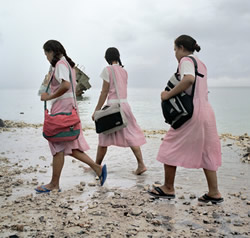 New Zealand politicians are engrossed in working out how persuasive a case they can make for lenient treatment in any post-Kyoto agreement. One hopes they can find time to consider the Pacific nations who are already suffering effects from climate change. Oxfam has followed up its overview report on the effects of climate change on developing countries, discussed earlier on Hot Topic, with a report specific to our own region The Future is Here: Climate Change in the Pacific. Basically the report says to Australia and New Zealand: here in your own backyard are people already suffering the consequences of global warming; you are among the rich countries most responsible for what is happening; there are things you need to do to help Pacific nations combat and adapt to climate change.