 Because the commenter known as “bill” is too lazy to dig up the last open thread, here’s a new one. There’s plenty to talk about (but there’s a post on extreme weather on its way, so hold fire on that) — including an interesting and developing stoush between George Monbiot, who thinks that growing extraction of unconventional oil and gas mean that peak oil’s no longer a threat, and others, who remain concerned. Why it’s complicated? Google EROEI.
Author: Gareth
This is our planet
[vimeo]44801709[/vimeo]
A wonderful video to start the weekend — time-lapse photography from the space station compiled by Tomislav Safundžić. If anyone ever tries to tell you that man’s influence is too puny to affect our great planet, point them at this. The world is littered with our lights, and much else besides. Watch the full HD version at Vimeo for the best effect.
Greenland melt record likely
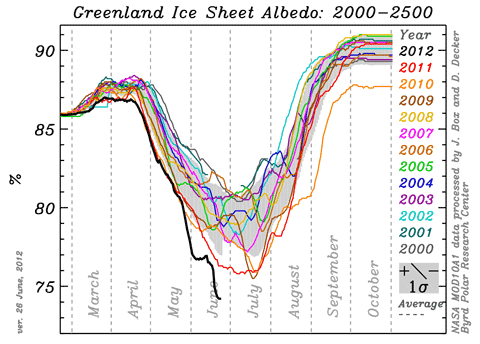
 Jason Box reports that the Greenland ice sheet darkening recorded in satellite albedo ((High albedo = very white, lots of reflection; low albedo = darker, more heat absorbed)) measurements is setting new records this summer, especially at high altitudes. Box recently blogged that ice sheet reflectivity this summer “has been the lowest since accurate records began in March, 2000”.
Here’s the latest “noodle plot” ((Looks like a spaghetti graph to me. What is it with climate people and pasta?)) (regularly updated here) for the ice sheet between elevations of 2,000 and 2,500 metres. 2012 (the black line) is well down into new record territory:
Box comments:
What I expect we will see if these low albedo conditions persist is 100% surface melting over the ice sheet. This would be a first in observations. It may not happen this year, but the trajectory the ice sheet is on, along with amplified Arctic warming, will have the ice sheet responding by melting more and more.
To see this darkening in action, have a look at the MODIS image of the west Greenland ice sheet here. You can see the surface melt spreading inland and upwards, grey ice dotted with blue lakes. Add another interesting, if depressing, graph to the panoply of information on the Arctic summer. The sea ice doesn’t look too good either…
In other Greenland-related news, a new study published in Proceedings of the National Academy of Science by Liu et al ((Zhengyu Liu, Anders E. Carlson, Feng He, Esther C. Brady, Bette L. Otto-Bliesner, Bruce P. Briegleb, Mark Wehrenberg, Peter U. Clark, Shu Wu, Jun Cheng, Jiaxu Zhang, David Noone, and Jiang Zhu. Younger Dryas cooling and the Greenland climate response to CO2. Proceedings of the National Academy of Sciences, June 25, 2012 DOI: 10.1073/pnas.1202183109 – PDF here.)), Younger Dryas cooling and the Greenland climate response to CO2 (Science Daily, PNAS abstract), looks at the ice sheet temperature record inferred from the oxygen isotope measurements taken from ice cores, and concludes that they may overestimate the extent of the Younger Dryas cooling. This is interesting stuff for those who have been following the Easterbrook story, because Don places great store by the ice core temperature record. He was wrong before this paper hit the presses, but he’s even wronger now!
Rio wrap: a real limp deal (where’s the way out?)
 So it ended, as have most of the recent UN conferences on climate change, with a statement of platitudes and good intentions but nothing in the way of firm commitments to action. George Monbiot called the conference text 283 paragraphs of fluff, The Economist called the outcome “a limp agreement” and “a poor result for a summit billed by some as a “once in a generation” chance to save the planet from its intolerable burden.” Despite warnings of ecological tipping points looming, and the world’s top scientific organisations urging action on population and consumption, the leaders of the world (or at least, the ones who could be bothered to turn up) managed only to boot the ball downfield about as effectively as an English footballer in a penalty shoot out. It was all just too difficult. So they left it for another day — perhaps another generation — to sort out.
Continue reading “Rio wrap: a real limp deal (where’s the way out?)”
Polar projections

This stunning view of the Arctic and the northern hemisphere was captured by the Suomi-NPP satellite a couple of weeks ago. You can clearly see where the Arctic sea ice is beginning to melt and break up (the bluish bits of offshore ice). More on the image at the Earth Observatory. Meanwhile, new research indicates that extreme Arctic warming and the break-up of the West Antarctic ice sheet may be closely linked, according to evidence from an amazing lakebed core from Russia’s Lake El’gygytgyn ((I’m glad The Climate Show is on sabbatical and I don’t have to attempt to pronounce that…)). From the Science Daily report:
Brigham-Grette, the lead U.S. scientist says, “What we see is astonishing. We had no idea that we’d find this. It’s astonishing to see so many intervals when the Arctic was really warm, enough so forests were growing where today we see tundra and permafrost. And the intensity of warming is completely unexpected. The other astounding thing is that we were able to determine that during many times when the West Antarctic ice sheet disappeared, we see a corresponding warm period following very quickly in the Arctic. Arctic warm periods cluster with periods when the Western Antarctic ice sheet is gone.”
Not good news.