Where the streets have no name

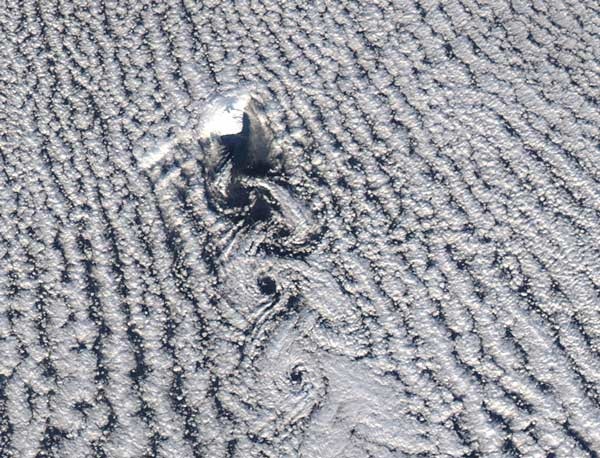
JanMayenvortexsmall.jpg

Not much of a climate connection here (though Greenland and sea ice are in the picture), but regular readers will know that I’m fond of looking down on the Earth from space. This image from NASA’s Earth Observatory shows a beautiful von Karman vortex street downwind of Jan Mayen island in the Greenland Sea (600 km N of Iceland, 500 km E of Greenland), surrounded by more conventional cloud streets running south off the sea ice. Click on the image for more detail, and check out the Wikipedia page for an excellent animation showing how the vortices form, and more pictures. We get them too: here’s a NASA satellite image from 2002 of a similar vortex street forming to the west of Mt Taranaki:
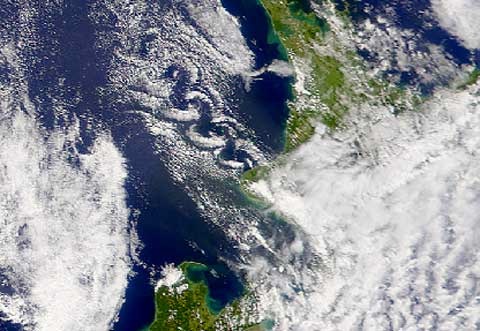
Taranakivortex.jpg

Normal climate service will resume shortly…
[Pet Shop Boys]
Reelin’ in the year

IPYWMO.jpg The International Polar Year (IPY) 2007-8 formally draws to a close today, and when today arrives in Geneva there will be a press conference to mark the release of a summary report, The State of Polar Research [PDF], which covers some of the preliminary findings. [BBC report here]. In the run up to this event, there’s been a blizzard (…sorry) of stories from the teams working at both ends of the world, and they make fascinating reading. From huge pools of freshwater building up in the Arctic Ocean to new mountain ranges as big as the Alps under Antarctica, methane plumes off Siberia and the death knell for summer sea ice in the Arctic, there’s a lot to cover…

Continue reading “Reelin’ in the year”

Right and wrong

dollarcloud.jpg

Estimating the economic impact of climate change and climate policy is controversial — not least in New Zealand, where some economists have been happy to generate specious forecasts to serve political purposes — so it’s a relief to read an article about climate change by a leading NZ economist that gets the issue “right”. Infometrics chief economist Adolf Stroombergen’s latest piece for the Dominion Post (which I saw in The Press business section on Saturday) correctly identifies that New Zealand’s primary vulnerabilities in the near to medium term are to the effects of climate change overseas, and to the actions other countries take to address the problem.

This will come as no surprise to readers of Hot Topic, as I’ve been emphasising this point for the last two years. However, while Stroombergen’s overall conclusion may be correct, his take on some of the underlying issues is a little less sure-footed.

Continue reading “Right and wrong”

Serendipity-doo-dah

longnowclock.jpg I get emails from several Oxfords, but this week’s best came from the nearest and contained a link to “a lecture you’ll find worth looking at — coffee/keyboard interface warning.” The warning was heeded and needed. The lecture, by Dmitry Orlov, given to the Long Now Foundation in San Francisco on Feb 13 as a part of Long Now’s Seminars About Long Term Thinking, is titled Social Collapse Best Practices [Long Now report here, full text at ClubOrlov]. According to Orlov, who had direct experience of social collapse in Russia after the demise of the communist system (his thesis is that the US is moving rapidly towards closing its “collapse gap” with Russia), four things are important during a collapse — food, shelter, transportation and security. But especially security:

Continue reading “Serendipity-doo-dah”

Moulin, not rouge


This Discovery Channel promotional clip shows scientists measuring the flow of water down a moulin on the Greenland ice sheet. Wonderful — scary — images. Asked to define the scale of the problem of ice sheet melt on a scale from 0 to 10, Jason Box, a glaciologist from Ohio State University answers: 11. More at the UK Telegraph.

For a different — winter — view of Greenland, NASA’s Earth Observatory has just published an article about scientists overwintering at Summit Camp, including a blog by remote-sensing glaciologist Lora Koenig. Great pictures. Love the polar bear…

[Red]