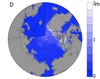
Estimates of when the Arctic will be substantially ice free in summer used to be out towards the end of this century. In 2007, the IPCC’s fourth report suggested that there would still be a fair amount of summer ice in the 2080-90s, but the record minima of recent summers have been forcing a rapid review of that expectation. We’ve had “rough” estimates of perhaps the 2030s, and even a suggestion it could happen as early as 2013 (follow the sea ice tag for earlier posts). A new paper by Wang and Overland in this week’s Geophysical Research Letters takes a more quantitative approach, by using six models and priming them with the sea ice state after the dramatic melt seasons of 2007 and 2008 (NOAA press release):
The area covered by summer sea ice is expected to decline from its current 4.6 million square kilometers (about 2.8 million square miles) to about 1 million square kilometers (about 620,000 square miles) – a loss approximately four-fifths the size of the continental U.S. Much of the sea ice would remain in the area north of Canada and Greenland and decrease between Alaska and Russia in the Pacific Arctic.
You can see the ice distribution in the small image at the top of the post (click on it for the larger original). The paper’s abstract tells us when this might happen:
Using the observed 2007/2008 September sea ice extents as a starting point, we predict an expected value for a nearly sea ice free Arctic in September by the year 2037. The first quartile of the distribution for the timing of September sea ice loss will be reached by 2028.
I interpret that to mean that the central expectation is 30 years, but some models suggest it could be a decade earlier. I wonder what effect that might have on the permafrost and methane hydrates… AP coverage here. Meanwhile, the NSIDC has declared this winter’s maximum extent was reached on February 28th, at 15.14 million km2 — the fifth lowest winter maximum in the record. They note:
The six lowest maximum extents since 1979 have all occurred in the last six years (2004 to 2009).
The betting season is now open. I’m on double or quits with Stoat (aka wmconnolley when he shows up here), but as he’s offering 2-1 to newcomers, I might be back to evens. I think I’m also betting with malcolm (Vibenna) again… I won’t offer any sort of form guide until later in the season, but (as ever) I’m hoping to lose, but at least half expecting not to.
[Jay & The Americans]

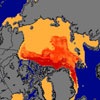 As winter turns to spring and the melt season begins, the Arctic sea ice looks to be primed for another bad summer. Multi-year ice is down to only 10% of the total extent — down from 40% during 1979-2000, and new work on ice thickness suggests that the ice cover is thinner than at any point in the recent past. At a NASA/NSIDC press conference discussing the new data, UC Boulder scientist Walt Meier commented: