
 Welcome to the fiftheenth post in the Sustainable Energy without the Hot Air – A New Zealand Perspective series. After our previous posts on hydro power, geothermal and wind (and a summary on the big three), solar, biofuels, marine and waste energy, we’re now attempting to answer the question:
How can we achieve a BIG reduction in our personal and national energy consumption?
Remember, as before, the units are in kWh/day/person – ie. if you ran a 40W lightbulb for 24 hours, it’d take ~1 kWh over the space of a day. We then divide it by person to give you a sense of the scale of the resource proportionate to the size of the population. Be sure to check out the methodology. For reference – we’ve been looking to replace around 55 kWh/d/p of energy currently generated by fossil fuels. Be sure to check out our treatment on road, air transport, home energy use and general consumption from the last few days.
Summary of Energy Use
Using the MacKay categories (but ignoring imported goods and energy spent overseas on air travel), our total energy use of 88kWh/d/p breaks down as shown in Fig.3:
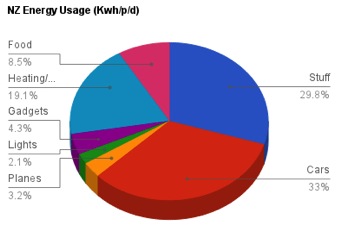
Fig.3 NZ Energy Use (by end use)
Continue reading “Sustainable Energy NZ #15: Keeping it lean and mean – a summary of energy use.”
 The New Zealand government has announced that the country will not join the second commitment period of the Kyoto Protocol (CP2), but will instead make voluntary commitments within the Kyoto framework [
 In this post Simon Johnson aka Mr February channels his inner General Westmoreland and his Vietnam flashbacks to look at National’s latest change to the New Zealand Emissions Trading Scheme (NZETS). Parliament has just (8 November) passed amendments that indefinitely defer any greenhouse gas obligations for agriculture and indefinitely discount obligations to industries.This is a ‘last helicopters off the Saigon hotel roof’ point in the sad history of the always-doomed-to-fail New Zealand Emissions Trading Scheme.
 Welcome to the fourteenth post in the Sustainable Energy without the Hot Air – A New Zealand Perspective series. After our previous posts on