Carbon offsets from a permanent forest sink project – keep it real

Project Rameka sequester and ride

In which I guest-post as myself and describe a carbon forest sink project I am involved in and our debate about whether we should provide carbon offsets to anyone as part of the project. I originally wrote this for the Greens Frogblog

Simon Johnson is a conservationist, tramper, accountant, former DOC worker and resource management consultant. Simon also blogs periodically at Hot-Topic.co.nz. In this guest post he writes about carbon offsetting from the point of view of a carbon forest.

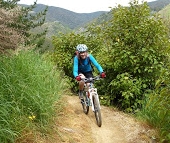
I am one of the trustees of a small 47-hectare carbon forest sink and native re-vegetation project and mountain bike park; “Project Rameka” in the east Takaka hills in Golden Bay.

It’s really a response to climate change made by two of my old friends, Bronwen Wall and Jonathan Kennett, who bought the land in 2008. Bronwen and Jonathan decided to apply their experience organising native planting projects in Wellington to climate change after reading the 2007 fourth report of the International Panel on Climate Change (IPCC).

It’s been embraced enthusiastically by the Golden Bay community who do the planting, pest control and track work through Project Rameka Inc.

The land is owned by a trust and I am one of the trustees. I did the early accounting for the trust and prepared the application to get the land into the Permanent Forest Sinks Iniative (PFSI).

In return for a 50-year covenant restricting the land use to forest, we receive about 800 carbon credits (specifically assigned amount units) per year for Project Rameka. These units started life as part of New Zealand’s 1990 baseline amount of ‘Kyoto’ units under the Kyoto Protocol.

How many units we get is based on the amount of carbon withdrawn from the atmosphere by the trees. Thanks to the Golden Bay weather, plants grow really quickly. So we really are storing carbon. We have seen 3cm annual growth rings in the few pines we have removed.

Continue reading “Carbon offsets from a permanent forest sink project – keep it real”
People talkin’ #10

A new open comment thread for the New Year, mainly because it’s too long since I posted the last one, but also because I’ve been declaring too many comments on recent posts to be off-topic. James Hansen‘s commentary on last year’s temperatures and the prospects for this year (pdf) is your starter for ten…

Meanwhile, I’m preparing a couple of talks for this weekend’s Coal Action Network Summer Festival near Gore. I’ll be briefing attendees on the state of the climate, and what we know about where we’re heading. There’s a session for the public on Sunday at the James Cumming Wing in Ardwick Street in Gore — I’ll be speaking at about 10-30 am. See you there? Failing that, I’ll probably post edited highlights of my thoughts next week.

Climate of complacency #2: de Freitas lies to TV3

Imagine my shock when I discovered today that Chris de Freitas — the Auckland University academic who hit the news a couple of years ago when it was found that he was teaching climate denial to first year students, but who has a 20 year history of advocating for inaction on climate change — had made headlines by telling lies to a TV news operation. The headline: Kiwi scientist: Climate change not to blame for heatwaves. For a while it was top story on the TV3 News web site. Here’s how the story opens:

A New Zealand scientist has denied popular claims the recent Australian heatwave and other extreme weather events around the world are linked to global warming.

Here’s where de Freitas plays fast and loose with the facts:

The Australian government’s Climate Commission released a report last week stating: “climate change has contributed to making the current extreme heat conditions and bushfires worse”.

But associate professor of climate and environment science Chris de Freitas, from the University of Auckland, says this is not the case.

“There is no evidence to suggest that,” he says. “It’s really [just] hype.”

There’s the lie. De Freitas states without qualification that there’s “no evidence”. And yet the Australian Climate Commission’s report on the subject, prepared by three scientists with a great deal more experience and scientific mana than junior geographer de Freitas, states:

Climate change has contributed to making the current extreme heat conditions and bushfires worse.

The report provides a long list of peer-reviewed scientific studies to support its conclusions. But de Freitas keeps on digging a hole for himself:

Dr Freitas says the earth actually hasn’t warmed for at least a decade, and scientists do not know enough about climate change to tell if carbon dioxide emissions could cause large or damaging changes.

“There’s no evidence to suggest that what we’re doing is creating dangerous change.”

Tell it to the firefighters, Chris. Tell it to the people of Dunalley. Tell it to the Australian people suffering as climate change comes home to roost.

There are several questions that have to be asked about this “news” item. Why did TV3 go to de Freitas for a story in the first place? Was de Freitas touting his contrarian lies to the media, or were his friends at the NZ Climate “Science” Coalition, where he rejoices in the role of “science adviser”, pushing his views to news operations running short-staffed during the summer break?

Auckland University, which allows de Freitas to teach rubbish to its students under the guise of academic freedom, has to ask itself if it can really stand behind an employee who so egregiously lies in public. Academic freedom should be cherished, but allowing de Freitas’s nonsense to go unchallenged devalues the very notion, and diminishes the university’s hard won reputation as a centre of academic excellence.

Climate of complacency: NZ Herald lazy and irresponsible

Saturday’s New Zealand Herald carried an astonishing editorial on climate change — remarkable enough to prompt me to tweet that it was “crass, complacent and so very wrong“, despite it being ostensibly in support of action on climate change. The piece begins by riffing on the wildfires in Australia, before observing:

With Australia having its two hottest days on record this week, and New Zealand enjoying a hot summer, it feels like climate change has arrived. But most scientists are wary about attributing any particular weather to global warming. To cite this summer as evidence would enable sceptics to recall last January’s washout.

“Most scientists” are being anything but wary about discussing the link between the Aussie heatwave and climate change. Australia’s Climate Commission released a special report on the heatwave at the end of last week. Here are the first three “key points” from the report:

  • The length, extent and severity of the current Australian heatwave is unprecedented in the measurement record.
  • Although Australia has always had heatwaves, hot days and bushfires, climate change is increasing the risk of more frequent and longer heatwaves and more extreme hot days, as well as exacerbating bushfire conditions.
  • Climate change has contributed to making the current extreme heat conditions and bushfires worse.

Straightforward enough, you might think. Climate change is making the heat and fires worse. But if the Herald editorial writer might be forgiven for missing a major report from the Australian body tasked with informing that nation about the realities of climate change, he or she cannot be forgiven for the astonishing complacency evident in the next few paragraphs.

Continue reading “Climate of complacency: NZ Herald lazy and irresponsible”

Still warming after all these years (again)

[youtube]u_0JZRIHFtk[/youtube]

Spread this excellent new video from the talented team at Skeptical Science far and wide. It explains why the latest denialist trope — no warming for 16 years — is rubbish. Take out the impact of the three biggest factors driving natural variations in the global average temperature — volcanoes, the El Niño Southern Oscillation and the solar cycle — and what’s left is the underlying upwards trend being driven by our CO2 emissions. The world’s warming, Australia’s burning, ice is melting and we did it. No room left for wishful thinking or complacency.