
I heard it through the grapevine

Grapes.jpg Could vineyards be the “canary in the coalmine” for climate change impacts on agriculture? British wine writer Robert Joseph in the Guardian [UK] covers some of the ideas that emerged in last month’s Barcelona wine and climate conference:

For anyone who feels they have finally mastered the concept of postmodernist books and architecture, there is a new intellectual and linguistic challenge, in the shape of “post-classic” wines. The term was coined by the world’s leading viticulturist Dr Richard Smart, at the second World Conference on Global Warming and Wine in Barcelona last month before an audience of the great and good of the wine world and – via a carbon-saving video link – Al Gore. If even a few of the alarming predictions made by experts at that event prove accurate, many of the world’s most famous wines may either simply cease to exist or be altered beyond recognition over the next 50 years. The effect of climate change will not be restricted to wine – but for Smart, wine may be “the canary in the coal mine of agriculture”.

It’s an excellent piece, well worth reading even if your only interest in wine is drinking the stuff. (Declaration of interest: RJ is an old mate, and I have a small vineyard).
Sail on sailor

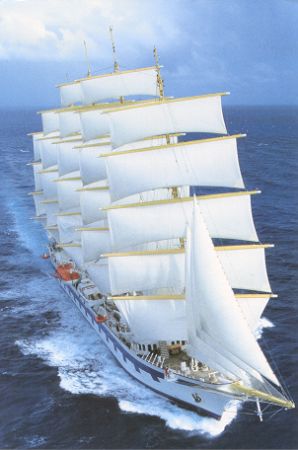
RoyalClipper01.jpg Pausing in my peregrinations in Nelson, where it rains (but not so much as in Golden Bay last weekend), I’m catching up on climate news. In Hot Topic I looked forward to the day when the first NZ wine clipper sailed into the Port of London, bringing the new vintage of sauvignon blanc to Britain’s drinkers (p156) – but I now find that the French have beaten us to it. The Herald reported (last month):

This month 60,000 bottles from Languedoc will be shipped to Ireland in a 19th-century barque, saving 22,680kg of carbon. Further voyages to Bristol and Manchester in England and even to Canada are planned soon afterwards. The three-mast barque Belem, which was launched in 1896, the last French merchant sailing vessel to be built, will sail into Dublin after a voyage from Bordeaux that should last about four days.

I like the words on the label: “Carried by sailing ship, a better deal for the planet.”
It’s a fast-moving world, this low-carbon image business. It would be a pity if the French beat us at more than the occasional rugby match…

Drinking wine spo-dee-o-dee

Grapes.jpg According to a Reuter’s piece in the Guardian [UK], New Zealand’s wine makers are upbeat about their prospects in a warming world. A warmer climate will increase the area suitable for producing fine wine, but it may mean changes in the grapes being grown.

Higher temperatures due to global warming are expected to make cold areas of New Zealand more temperate and better suited to grape cultivation. So it’s no surprise that New Zealand wine-growers are upbeat about a future that includes climate change. “The big picture for New Zealand wine is very, very good,” said Philip Gregan, chief executive of industry body New Zealand Winegrowers.

A rather nice confirmation of the view I expressed in Hot Topic. One of the interviewees is Clive Paton of Ata Rangi, a name to conjure with in the world of NZ red wine:

Paton said the Martinborough climate is ideal for producing Pinot Noir, but a slight rise in the temperature would be enough to tip the balance. So Paton has been looking at Syrah, also known as Shiraz, getting to grips with the nuances of an alternative variety, in preparation for a potential shift. “Even if it does rise a half or one degree, it’s still going to be a great place for growing grapes,” said Paton.

Very true. Good job we have some syrah chez Hot Topic. But what if the warming is not so moderate…? The rest of the world is worried. Discovery Channel covers the second Climate Change & Wine conference, being held in Barcelona this weekend. Pancho Campos, the president of the Wine Academy of Spain, who organized the conference, also thinks we might be on to a good thing:

The French “Grand Crus” could be further threatened by the “New World” wines of Australia, California, Chile, Argentina, South Africa and New Zealand, who would have the best climatic conditions. “The countries in the southern hemisphere are next to a greater mass of water, and it is sea currents which maintain the temperature at its level,” said Campos.

Agence France Press coverage here.
[Update 21/2: The Herald picks up the Reuters story and expands it with a few (fairly old, I think) quotes from NIWA’s Jim Salinger. Interesting that the Herald predicts that we might be growing sauvignon blanc in Canterbury in 20 – 30 years. I wonder what that means for the 250,000 sav blanc vines already down the road from me….]

Listen to the rhythm of the falling rain

raindrop.jpg I usually save my thoughts on weather for On The Farm (the other blog), but this summer in the Waipara Valley – especially the last 24 hours – has set me thinking. As the climate warms, Canterbury is projected to see an increased frequency of drought conditions. At the same time, the rain that does fall will become more intense, which could lead to run-off and erosion problems. Summer 2007/8 has been dry and hot (2007 was the driest at Limestone Hills since 1998, only 496 mm in the farm rain gauge). The hills are brown, the sheep are thin, but grape growers are happy. Yesterday afternoon, the skies darkened, thunder started rumbling, and the rain came. At 8 am today we’d had 92 mm in 24 hours (most it fell overnight, and it’s still raining at the time of writing). Other places have had a lot more, and there have been flash floods. It’s nothing by West Coast standards of course, but it’s good and heavy in North Canterbury terms.

So if you were to ask me what will Canterbury’s climate be like in 2030, I’d have to answer – just like this summer…

[Caveat: Yes, I know that we’ve got a La Nina and that one year does not a climate make.]