The cracks are showing #2 (polar notes)

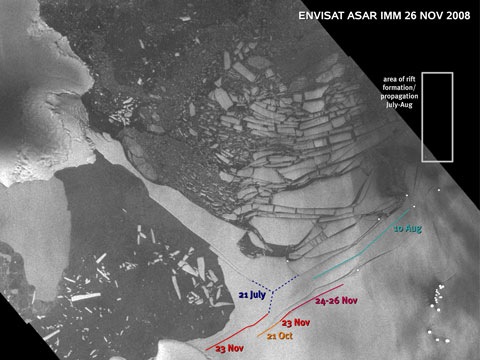
wilkins26nov480.jpg

Summer’s arriving on the Wilkins ice shelf, and its disintegration continues. New cracks are threatening to destroy the ice “bridge” that’s been holding the ice shelf pinned between Charcot Island (top left) and the Antarctic peninsula. This picture, captured by the European Space Agency’s ENVISAT satellite on November 26, shows the new cracks (coloured lines) and the dates they first appeared (NASA version here). If the chunk of ice under “21 July” breaks away, the long thin bridge will lose support and follow suit, the ESA analysts say.

Meanwhile, a team lead by Richard Alley at Penn State has worked out that ice shelf calving – where icebergs break away at the edge of an ice shelf – is critically influenced by the rate at which the ice shelf is spreading out. The PSU release notes:

For iceberg calving, the important variable — the one that accounts for the largest portion of when the iceberg breaks — is the rate at which ice shelves spread, the team reports in the Nov. 28 issue of Science. When ice shelves spread, they crack because of the stresses of spreading. If they spread slowly, those cracks do not propagate through the entire shelf and the shelf remains intact. If the shelf spreads rapidly, the cracks propagate through the shelf and pieces break off.

When ice shelves break up, the glaciers that feed them can speed up noticeably, dumping more ice into the ocean. Over recent years, the role of water as a lubricant for glacier flow has been receiving a lot of attention (rubber ducks were recruited as under ice research tools in Greenland this year), and the BBC reports that a sub-glacial “flood” under the Byrd Glacier which feeds ice at the rate of about 20 billion tonnes a year into the Ross ice shelf caused that to increase to 22 billion tonnes over 2006. It has since returned to normal.

Up north, the NSIDC reports (Dec 3) that it continues to be warmer than average, even though the sea ice is now covering the whole Arctic ocean.

Hot, flat and crowded

The following column was written for the Waikato Times in October.  For the Hot Topic posting I’ve brought the final paragraph up to date,  recognising that Obama will head the new administration. Hopefully that will lend substance to Friedman’s optimism.

Thomas Friedman’s recently published book Hot, Flat, and Crowded offers ground for cautious hope in the crisis now upon us. A three times Pulitzer Prize winner, Friedman is well known as the foreign affairs columnist for the New York Times and for his previous best-selling book The World is Flat, which explored the realities of globalisation.

Friedman is an enthusiastic American. Some of his views on international politics have little appeal for me.  But this book, properly, is well beyond any political alignment.  It faces up to global warming and biodiversity loss, sees how real and dangerous they are, and urges nothing less than a green revolution in America as the only way out for that country and indeed for the world.

As a leading journalist Friedman has had access to many leaders in science and industry and finance.  The result is an energetic and credibly detailed account of how America can move to clean energy.  Friedman is comfortable with a market economy and sees it delivering what is needed, but he is equally sure that its success depends on clear directives and regulations being put in place by federal government. He urges business to see the green revolution as opportunity not threat.

It is easy to despair when considering America.  For eight wasted years the Bush administration has refused to take measures to combat the climate change for which it, of all countries, carries the most responsibility. In annual emissions America as a country may now have been overtaken by China, but its per capita emissions are far greater and its past contribution to the level of carbon dioxide now in the atmosphere dwarfs anything China has achieved. The administration’s neglect of the issue, fed by scientific ignorance and susceptibility to powerful lobbying interests, has been staggering.

Yet it is America which provides many of the leading scientists who have uncovered the complex processes of global warming.  American politician Al Gore has done more than any other person to alert the world to its dangers.  California, the world’s seventh largest economy, has committed itself to large emissions reductions.  Other states and cities are following suit. America’s potential to lead the world in a green transformation is enormous.  Its fine universities, its technological capabilities, its wealth, if harnessed for the purpose make the revolution conceivable. Friedman, aware of both the negative and positive aspects of American society, settles for a sober optimism about what can be achieved.

He considers a change in America will also be the answer to China’s current reliance on dirty fuels.  China will suffer dreadfully from climate change as droughts and floods increase and crop yields diminish.  They must be aware of this and will surely follow any lead America offers towards clean energy.  Friedman visits China regularly and has ferreted out evidence of moves there towards a greener economy even in the midst of the headlong rush to fossil fuel-powered growth. He reports encouraging developments which, though nowhere near enough, indicate that China could follow an American lead.

We know all too well in New Zealand how hard it is to get political traction on this most serious of matters. The modest emissions trading scheme has met fierce opposition and looks likely to be diluted even further. Only a few politicians treat the question with the gravity it deserves, and most of the electorate still seems unaware of what looms threateningly for our children and grandchildren.

Here’s hoping that Friedman’s sober optimism proves justified and that Obama will, as he has recently announced, prevaricate and delay no longer but take up the task on which the human future now urgently depends.
The tracks of my tears

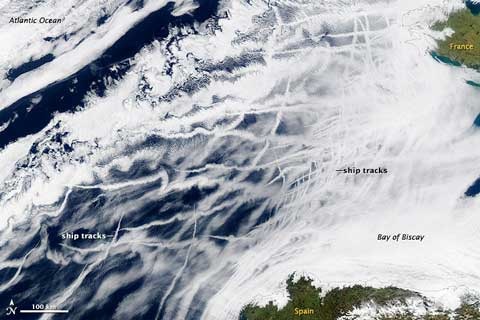
EarthApollo8.jpg NASA was 50 years old last July, and the Earth Observatory has been celebrating by reviewing some of the classic images they’ve captured over the years. The image of the Earth at left was captured by Apollo 8 astronauts on December 22nd 1968 – one of the first “blue marble” pictures. Forty years on, it’s sobering to realise that only 24 people have seen the planet from this perspective – from the moon. But the picture that really caught my attention this week was part of a feature where NASA asked earth scientists what “unique insights” spaceflight had given us about the planet.

shiptracksbiscay.jpg

On page three, you’ll find this stunning image of “ship tracks” – the maritime equivalent of the contrails left by high flying aircraft – over the Bay of Biscay. If you ever doubted man’s influence on the atmosphere, here’s a dramatic confirmation of the large scale impacts brought about by our modern way of life. There are also satellite maps of ENSO sea level changes, Arctic sea ice decline, La Niña-related sea level changes, and many more pretty pictures. Educational eye candy.

[Title reference]

Don’t be a Rodney, John Key!

IanMcEwansmall.jpgDon’t be a Rodney, John, be a Barack on climate change. That’s the central message of the new Don’t be a Rodney, John Key! blog, created to promote a letter-writing campaign to our new leader, urging him to ignore ACT’s call for inaction and recognise that this is an issue that demands clear, consistent leadership. Blogger Morgan points out:

The world is watching. On Tuesday 18 November, Barack Obama made a powerful statement that was heard around the globe: “Now is the time to confront this challenge once and for all. Delay is no longer an option. Denial is no longer an acceptable response. The stakes are too high. The consequences, too serious.”

Delay? Denial? He’s talking about Rodney!

I wholeheartedly endorse Morgan’s campaign. Write a letter or send an email to Key (details of how on the site), politely urging action. Join the Facebook group. I’m going to write to Key, Nick Smith and my constituency MP, Colin King. I hope they’ll listen.

But I’m not holding my breath.

PS: Russell Brown covers the ACT denial deal in detail here. Worth a read (h/t Carol).

PPS: Jeanette Fitzsimons has a punchy post on Key’s options over at Frogblog.

There she goes, my beautiful world

IanMcEwansmall.jpg Ian McEwan is one of my favourite writers. By chance, whilst reading George Monbiot’s latest offering in the Guardian this morning, I stumbled on a link to an essay by McEwan welcoming Barack Obama, outlining the considerable climate policy challenge he (and we) face. The world’s last chance is a superb summary of the current situation, and a masterful piece of writing. Any article that starts like this deserves a read:

‘I refute it thus!” was Samuel Johnson’s famous, beefy riposte one morning after church in 1763. As he spoke, according to his friend James Boswell, he kicked “with mighty force” a large stone “till he rebounded from it”. The good doctor was contesting Bishop Berkeley’s philosophical idealism, the view that the external, physical world does not exist and is the product of the mind. It was never much of a disproof, but we can sympathise with its sturdy common sense and physical display of Anglo-Saxon, if not Anglican, pragmatism.

Still, we may have proved Berkeley partially correct; in an age of electronic media, where rumour, opinion and fact are tightly interleaved, and where politicians must sing to compete for our love, public affairs have the quality of a waking dream, a collective solipsism whose precise connection to the world of kickable stones is obscure, though we are certain that it exists.

His take on the state of play echoes mine (and Monbiot’s), but he puts it much better than I (or Monbiot) ever will:

Within the climate science community there is a faction darkly murmuring that it is already too late. The more widely held view is hardly more reassuring: we have less than eight years to start making a significant impact on CO2 and other greenhouse gas emissions, eight years to move from Berkeley’s solipsism to Johnson’s pragmatism. Thereafter, as tipping points are reached, as feedback loops strengthen, the emissions curve will rise too quickly for us to restrain it. In the words of John Schellnhuber, one of Europe’s leading climate scientists and chief scientific adviser to Angela Merkel, the German chancellor, “what is required is an industrial revolution for sustainability, starting now”.

If you read nothing else today, read this. And the Monbiot’s worth a look too, as is the Nick Cave title reference…

[Title reference]