Cold moments

arcticmethane.jpgMore data on the state of the methane hydrates on the Siberian shelf emerged during the American Geophysical Union’s Fall meeting in San Francisco this week. At a press conference covering recent work in the Arctic, Igor Semiletov, the leader of the team working on the Yakov Smirnitsky last (Arctic) summer, told reporters:

“The concentrations of the methane were the highest ever measured in the summertime in the Arctic Ocean,” Semiletov said. “We have found methane bubble clouds above the gas-charged sediment and above the chimneys going through the sediment.” [Science Daily, e! Science News]

A reporter at the press conference, who blogs at A Change In The Wind, asked Semiletov if the increase in methane release his team had discovered constituted “a global emergency”. In his blog entry he writes:

[…] his struggle with the question was evident. I tracked him down later, and asked if he felt he was the wrong person to be answering such a huge question. He admitted his discomfort, but said he thought it was the best question he was asked, and insisted:

“I am the person responsible for this research, and I think we have to tell people that something is happening now with the subsea permafrost.”

Why? A Change In The Wind explains:

Semiletov thinks that if just 1% of the ESAS methane is released, it will push total atmospheric methane up to 6 parts per million, and cites researchers such as David Archer in arguing that this would push us past the point of no return, towards runaway global warming.

Six ppm methane is a little over three times the current level, and with a global warming potential of 25, is equivalent to 150 ppm CO2, or 50 years worth of current annual CO2 emissions. There’s no reference to any time scale for this release, but the possibility should be enough to ring alarm bells — and loudly.

[There’s plenty of other Arctic/climate related material to blog from the Fall AGU meeting, and I’ll get to some of it soon, but for the time being Christmas shopping looms…]

[Title reference]

Sitting in limbo

Parliament has risen for the summer recess, and New Zealand’s climate policy is reduced to a train wreck of repealed legislation and uncertainty about the emissions trading scheme. PM John Key confirmed under persistent questioning by Greens co-leader Jeanette Fitzsimons yesterday that the ETS would not actually be put on hold. From Hansard:

Jeanette Fitzsimons: With regard to those parts of the emissions trading scheme that came into force on 1 January 2008—relating to forestry—will the Prime Minister or will he not put on hold the penalty regime for deforestation during 2008, and the credits that foresters expect to claim in January 2009 for the carbon sequestered by their forests this year?

Hon JOHN KEY: The current legislation and rules about deforestation stay in place, pending the outcome of the select committee.

Jeanette Fitzsimons: In that case, what precisely is the Prime Minister suspending or putting on hold, given that nothing else is due to come in until 2010 and he is retaining the parts that are already in force; or is the Prime Minister saying that the forestry bit may be taken out of force later, which means they will have to give their credits back?

Hon JOHN KEY: That is exactly the point. Nothing is coming in until 2010 outside of forestry. The high-level select committee will have reported back. It is the hope of the Government that the legislation that will replace the existing emissions trading scheme legislation will be in place long before January 2010.

Fitzsimons take on the exchange at Frogblog is worth a read. Meanwhile, let’s run through a little history. When the ETS was first launched, National supported it. Then they withdrew support for the legislation in the run-up to the election, but campaigned on keeping the basic ETS structure while tinkering with (also known as watering down) the settings. Post-election, to pacify Rodney and his pack of cranks, the ETS was to be put on hold while a select committee considered, amongst other things, whether a carbon tax might be better. Now, on the last day of this session, we learn they’re not going to do that, and the legislation stands until amended.

If this seems like a government that doesn’t know what it’s doing, then I’m not the only one to notice. Brian Fallow in today’s Herald is withering in his criticism. He notes Australia’s new — and disappointing — targets for carbon dioxide reductions:

It ill behoves anyone on this side of the Tasman to be scornful about that, however. At least the Australians have an intermediate target. We have none. At least they have a climate change policy. Ours is in shambolic limbo.

Worse, Key considers that the Rudd government is on the right track, describing Aussie policy as “a very considered and balanced approach to climate change” in Parliament. As Fallow memorably concludes:

Given the countries’ different starting points, Australia’s mid-century target of a 60 per cent reduction in emissions from 2000 levels is similar to National’s 50 per cent from 1990 levels. But while Rudd is taking at least baby steps in that direction, Key is performing some kind of pirouette.

It’s an unedifying spectacle.

[Title reference]

The sound of failure/It’s dark… Is it always this dark?

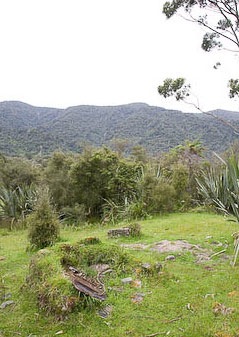
Mackenzie.jpgForgive me this riff on impermanence. Last Sunday morning, my little group of middle-aged winos and winemakers (plus a professor or two) left the lodge in Martin’s Bay and crossed a serene Hollyford River on a jetboat. We walked along the edge of the bush on the spit, looking at Maori middens, layering in sand dunes, native plants and the succession from pingao to rimu, pondering the most recent ice age — which carved out the Hollyford valley — and the potential for rising seas to change this wonderful example of coastal ecology. Eventually we arrived at the site of the Mackenzie homestead – built in the 1870s by hardy settlers determined to make their lives in this wet and wild corner of what was then a new land to Europeans. All that remains is the stone fireplace, overgrown with grass, the vague outline of the walls, and some imported trees — the gums are doing very well. I pondered the lives of the settlers in the Hollyford and the scratches they left on the landscape, while New Zealand and the world grasped at bigger issues…

Continue reading “The sound of failure/It’s dark… Is it always this dark?”

Six Degrees

This posting is based on a Waikato Times column written in July.

The Royal Society in the UK awarded its 2008 science writing prize to Mark Lynas for his global warming book Six Degrees: Our Future on a Warming Planet. I found the book telling when I read it last year, and it was good to see it receive this confirmation.

Lynas’s first book High Tide, published in 2004, grew out of three years visiting parts of the globe where the signs of global warming were becoming evident – Alaska, Tuvalu, Mongolia, Peru, the US.  Six Degrees had a different genesis. It is the result of many months in the Radcliffe Science Library at Oxford trawling through scientific journals to find the peer-reviewed papers on which the book is entirely based.  The source material ranges from computer model projections to studies of climate in the past. Lynas is not a scientist, but he makes it his business to adequately understand and interpret what the scientists have written in their specialist fields.

Sceptics often scoff at computer models as somehow fiddled in advance, but Lynas points out that they are based not on subjective judgements by their constructors but on the fundamental laws of physics.  They have grown increasingly sophisticated and the insight they offer into likely future conditions on the planet is something humanity has never had access to before.  One check on their accuracy is ‘hindcasting’ the 20th century, and some of the most powerful recent models have done this with almost unerring accuracy.  Not that Lynas suggests that they are infallible in their forecasts.

Six Degrees is a highly readable narrative for the general reader, tracking through what changes can likely be expected from each degree of global warming from one degree through to six degrees, the upper limit for worst case scenarios.

Even at what may seem comparatively low rises of one or two degrees centigrade he finds plenty to cause alarm. A few of his examples:  possible desertification and abandonment of agriculture over millions of square kilometres in the US, an extremely hot and drought-ridden Mediterranean Europe, an ice-free Arctic ocean with implications still difficult to understand, the bleaching and likely death of many coral reefs, major loss of food production in India, serious population displacement in Bangladesh. On through three and four degrees the book points to desertification intensifying in many places, water supply severely declining in Pakistan, the Amazon rainforest dying, far more of Australia burning and suffering serious drought, the West Antarctic ice sheet facing collapse, sea levels rising threateningly. Five and six degrees hardly bear contemplating as the possibility is faced of methane hydrates on subsea continental shelves becoming destabilised and venting into the atmosphere, adding an enormous feedback to global warming.

As a writer for the general public Lynas doesn’t shrink from putting emotional depth into his analysis.  He explains in a Guardian column: “If I’ve read a paper about coral bleaching or precipitation trends in the Sahel, I need to be able to describe what this means in the real world – grey weed creeping over once-vibrant coral reefs, and Sudanese herders struggling to feed their children as their livestock starves around them and a dust-storm looms on the horizon.”   However he sees his first duty as accurately representing what he has read in the scientific literature.   The Royal Society judges are clear that he has met this test. They state that the book provides a good overview of the latest science on the issue. An interesting response came from  Eric Steig, one of the contributing scientists to the Real Climate website, when he reviewed the book in Conservation Magazine. Initially he had assumed from news reports that the book was alarmist and probably not worth reading; however, after reading it he reported it firmly based on published scientific literature and nowhere exceeding those bounds. Alarming, yes, but not alarmist.

There is no escaping that the science is alarming. That is why this issue is of such overwhelming importance. Yet like most writers on the subject Lynas hopes that we can yet avoid the worst prospects. There is already unavoidable further warming ahead of between 0.5 and 1 degree Celsius, but it is possible that we might manage a ‘safe landing’ within the 1-2 degree corridor if appropriate action is begun now to drastically reduce greenhouse gas emissions.

This is the point at which the question moves from science into the realm of the political. We largely know how the needed reductions could be achieved.  The question is whether we find the collective will to do it.  The fact that that is still an open question indicates the full reality of the science has not dawned for enough of us.   Books like Six Degrees need wide readership. Hopefully the Royal Society prize will assist that.

It is worth noting that Six Degrees was published in America by National Geographic, which has also made a television documentary based on the book and broadcast on the National Geographic channel internationally. On a lighter note Lynas also achieved minor fame as a somewhat younger man in 2001 by throwing a cream pie at Bjorn Lomborg, the ‘sceptical environmentalist’. “I wanted to put a Baked Alaska in his smug face in solidarity with the native Indian and Eskimo people in Alaska who are reporting rising temperatures, shrinking sea ice and worsening effects on animal and bird life.”
Walkin’ back to happiness

Last post for a few days. I’m off to Fiordland to “do” the Hollyford Track. I hesitate to say “walk” because jet-boating and planes are involved and real trampers might be tempted to sneer, but I do need real boots and a backpack. It may rain (but the forecast is pretty good). My companions will be a bunch of miscellaneous middle-aged winos (and a winemaker), and eating good food and drinking fine wine will be required. My camera will be ready to snap any moa that might stroll by. If I get back safely, blogging will be resumed on Monday afternoon next week.

[Update 15/12: Three days in a rainforest with no rain, and only one sandfly bite. Two brilliantly sunny days and one cloudy. As I missed out on the full Fiordland experience, I requested a discount. It was refused… 😉 ]

[Title reference]