Ice, Mud and Blood

Ice, Mud and Blood: Lessons from Climates Past

In the recently published Ice, Mud and Blood: Lessons from Climates Past British geologist Chris Turney describes how scientists are building up knowledge of the earth’s climate in the past and what it might mean for our future.  He describes attending a showing of The Great Warming Swindle in Australia in 2007. He remarks on the panel discussion which followed when questions were taken from the audience: “…I suddenly realised that many of my companions were either loonies or had been very badly informed. It struck home just how poor a job we’ve done as scientists in communicating our work.”

I’m not sure that the scientists are altogether to blame, but certainly his book makes amends if they are required.

He selects various periods in the past when the climate changed and reports on the current thinking about what caused those changes. Along the way he provides fascinating stories of how the jigsaws have been assembled from a great variety of pieces of scientific investigation.

His first two periods are very distant. One 55 million years ago, the drastic warming over a period of 160,000 years, known as the Peleocene-Eocene Thermal Maximum (PETM), on which Gareth had a recent post. The second from 540 million to 1000 million years ago when it appears that the globe was almost covered in ice during at least three ice ages. Acknowledging that these events happened when the patchwork of continents was different from our time he moves closer to the present in the remainder of the book. He begins a mere 2.5 million years ago when the earth became locked into the bout of ice ages and inter-glacials which continue to the present. His subsequent chapters narrow the focus to episodes within that period: a warm stretch in the last interglacial from 130,000 to 116,000 years ago; the up and down progression from then  towards the Last Glacial Maximum 21,000 years ago; the tumultuous time which marked the end of that last ice age from 21,000 to 11,700 years ago; and what it has meant to the conditions of life for humans to be in the comparatively settled, but by no means uniformly even, climate of recent millenia.

The book carries intrinsic interest in its accounts of how the changes in the past are reconstructed. The evidence gained from ice cores and ocean bed cores is always astonishing in its detail and complexity. The range of information that can be prised from the shells of foraminifera, ancient ocean-dwelling organisms, is extraordinary.  The sheer excitement of discoveries which confirm other discoveries carries a drama which the author is well capable of communicating. Clearly paleoclimate is an absorbing and rewarding area in which to work.

But Turney is much concerned with its lessons for the present. Understandably, considering the likely causes of past changes. Greenhouse gases are always an important part of his picture. For example the PETM was probably triggered by the release of a vast amount of carbon into the ocean and atmosphere over less than 2000 years, likely to have been methane from ocean sources. This was enough to drive a massive warming over 30,000 years or so.  The warm conditions persisted for another 60,000 years.It then took another 70,000 years before temperatures started to drop and return to what they were before, with the oceans playing a different part at this stage in gradually sucking greenhouse gases out of the air. The implications for us today?  If we exhaust the available fossil fuels we will release more carbon than was released at the beginning of the PETM.

Another lesson from the past is the importance of positive feedbacks in the climate system, when the changes that have occurred trigger new and greater changes than the original cause on its own would account for. There is a warning for us that a cascade of unintended consequences can follow from apparently small beginnings. “A little more greenhouse gas in the air does not cause a little change in climate.”

A further lesson is the rapidity with which changes have sometimes happened in the past as tipping points were reached. Abrupt shifts in the climate system are quite possible, as is illustrated, for example, in his account of the sudden reversals which marked the progress towards the Last Glacial Maximum.

Summaries like this unfortunately obscure the pleasure and interest of the book which lies in the wealth of detail it contains and the cheerful clarity with which it is ordered and conveyed to the reader. The underlying earnestness of the author’s concern about the direction we are headed is unmistakable but there is nothing ponderous about his narrative.

Incidentally the author has spent time in New Zealand and describes being able to correct a faulty carbon-dating of wood in the Franz Josef glacier’s Waiho Loop moraine to show that the glacier surge was 13,100 years old and thus contributory evidence of a southern hemisphere cooling at a time when the northern hemisphere was warming. This phenomenon he discusses in the context of his account of the abrupt veerings which marked the end of the last ice age.  His connection with New Zealand includes a directorship in the new young company Carbonscape which is using a world-first microwaving technology to make charcoal.  I expect to post about that soon.
Bright future in sales

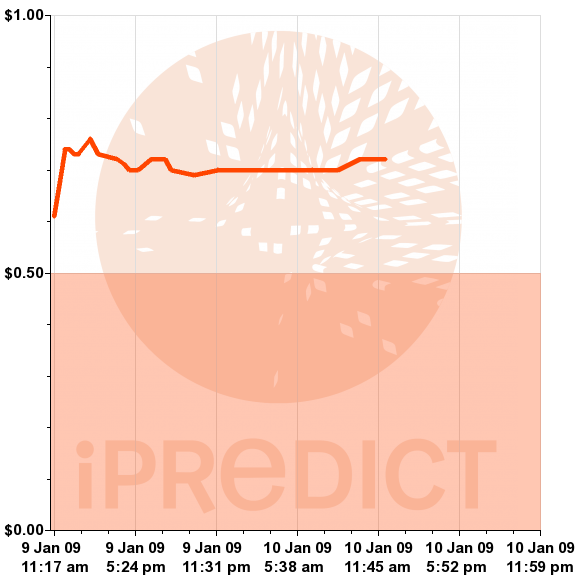
2009iPredict.png iPredict, the NZ-based “prediction market” has offered two new contracts based on global temperatures: will 2009 be warmer than 2008, and will 2009 set a new record for warmest year? TV3 News featured the offerings last night. In iPredict’s market, buying and selling contracts — the equivalent of stock trades in a traditional market — establishes what the market (ie, the collective wisdom of the buyers and sellers) considers to be the most likely outcome, and expresses that view in the price. At the time of writing, the $1 contract “2009 warmer than 2008” (TEMP.2009) was trading at $0.7041, indicating that the market view is that it will be. On the other hand, a new record (TEMP.2009.HIGH) was trading at $0.1840, suggesting that the market deems it unlikely.

iPredict’s blog explains the thinking behind the contracts:

2009 is shaping to be an interesting year for climate science. There are, as I understand it, two camps in the climate change community. One says that greenhouse gases is a major driver of changes in climate. The second says changes in the Sun’s energy output is responsible. What makes 2009 interesting is that these drivers are expected to head in opposite directions – greenhouse gas concentrations will continue their inevitable march upwards, but the Sun’s energy is expected to continue falling. So which driver will temperatures tend to follow in 09?

Unfortunately, whether 2009 is warmer than 2008 tells us nothing about long term climate “drivers”, because there’s too much noise in the system (the variation from year to year is bigger than the signal we’re looking for — an approximate 0.2ºC per decade increase – so we need to look at long time periods to establish its existence). The swing from El Niño to La Niña — a natural oscillation — has more effect in the short term than any annual increase in CO2 forcing.

The “new record” contract is potentially more interesting, because if there is a long term upward trend (and there is) then eventually there will be a new record. That could take some time to happen, though, as Tamino demonstrated in this excellent post at Open Mind.

For what it’s worth, here’s my take. 2008 began with a very strong La Niña, which has a cooling impact on global temperatures, so unless there’s an equally strong cooling event 2009 should be warmer. On the other hand, the latest prognostication from NIWA suggests that “moderate La Niña conditions are expected to prevail into [SH] autumn”, so perhaps things may not be clear cut until much later in the year. For 2009 to set a new record, ENSO would need to swing into an El Niño early in the year, and that now looks very unlikely — hence, I would guess, the price for that contract.

To measure the market confidence in the two views on climate drivers, iPredict would need to offer longer term contracts — 2009-18 average warmer than 1999-2008, for instance, but that might not be good for active trading. There are other climate-related contracts they could offer, though, and a new record minimum for Arctic sea ice in 2009 might be a good one. That might persuade me into the market…

[Fountains of Wayne]

Cry me a river

marbles.jpgI missed out on the field trip to the Waipara Gorge to look at the evidence for tropical temperatures around Eocene New Zealand, laid low by the dreaded lurgy, but TVNZ sent a film crew so that I could see what I missed. Plenty of big hammers on display… Meanwhile, GNS have sent along more details of the conference symposium on Wednesday next week (Jan 14), and it looks fascinating. One highlight (from the GNS release):

The symposium will conclude with a public lecture by Professor James Zachos from the University of California, Santa Cruz, on “Rapid global warming and ocean acidification 55 million years ago: Lessons for the future” in Oceania at Te Papa, 5.30-6.30 pm.

I don’t often wish that I lived in Wellington, but this is one occasion… 😉

Tell it like it is

NZETS.jpgThe select committee established to review the Emissions Trading Scheme (ETS) is now accepting submissions, and controversy over the precise interpretation of the terms of reference is already looming. As I noted last year, the terms were drafted by ACT and adopted wholesale by the government, with the exception of the removal of a review of the science of climate change. That was replaced by this clause:

• identify the central/benchmark projections which are being used as the motivation for international agreements to combat climate change; and consider the uncertainties and risks surrounding these projections

The Standard considers that this opens the door to Rodney Hide and his mates in the ranks of the cranks, while David Farrar at Kiwiblog leaps to its defence:

So when you hear people rail against the considering the uncertainties and risks of projections, they are actually railing against people understanding the science, and reading the IPCC reports.

No, David, they are railing against the use of that clause to introduce a review of the underlying science — which is what Hide is adamant he’s going to do, and committee chairman Peter Dunne is equally certain he’ll veto. However, the precise wording of that section is so vague that it is capable of multiple interpretations. Time to pull it to pieces…

Continue reading “Tell it like it is”

Coppiced willow farming here

This column appeared in the Waikato Times in August 2008.  I have altered some of the wording to update it for this Hot Topic post.

The change to renewable energy sources can seem daunting. Those with stakes in fossil fuels are often negative, claiming change will be too expensive, too difficult, or not yet necessary. Cries of economic doom have greeted even the modest emissions trading scheme which may or may not be carried forward by the new government.

It was encouraging therefore to read a few months ago of the plans of renewable energy company Pure Power to launch a variety of shrubby willow as a biofuel crop in New Zealand. Biofuels which use food crops or destroy rainforests have had a justifiably bad press. But not all biofuel crops are equal. Coppiced woody plants like the willow Pure Power plans to use have a very good ratio of energy output to the energy put into converting them; they can be grown on poorer soils not used for food production; they require little fertiliser or irrigation; using new technologies they will produce not only biofuel but also a range of products for making paints, resins, adhesives and bioplastics.  Pure Power will have nursery stock ready for planting this year and hopes for a rapid expansion of planting in subsequent years.

Continue reading “Coppiced willow farming here”