The legacy of our release of fossil fuel CO2 to the atmosphere will be long-lasting. It will affect the Earth’s climate for millenia. We are becoming players in geologic time. That is the conclusion that climatologist David Archer shares with a general audience in his newly published book The Long Thaw: How Humans Are Changing the Next 100,000 Years of Earth’s Climate.
The author is a professor in the Department of The Geophysical Sciences at the University of Chicago and a contributing editor at Real Climate. His book is relaxed in style, almost conversational sometimes, repetitive on occasion, but nevertheless closely focused and packed with instructive detail. It was a pleasure for a non-scientist like me to read. He seems to understand how to illuminate processes for the general reader. For example, his chapter on the distribution of carbon in the atmosphere, the land and the ocean, and his explanation of the interactions between them in the carbon cycle, provided angles and information that pulled together satisfyingly the bits and pieces of my hesitant understanding. Similarly what he writes about the acidifying of the ocean by CO2 and the part calcium carbonate plays in slowly neutralising its effect is a model of lucidity.
The book’s structure is simple. There are three sections. The first describes the situation we are in right now – meaning the 20th and 21st centuries. The second section is about the past, investigated as a forecast for the future. The final section looks into the deep future.
Archer produces no surprises about our current situation. The basic physics of the greenhouse effect – that gases in the atmosphere that absorb infrared radiation could eventually warm up the surface of the earth – was described in 1827 by the French mathematician Fourier. Then in 1896 Swedish chemist Arrhenius estimated the amount of warming that the Earth would undergo on average from a doubling of the atmospheric CO2 concentration – what we now call the climate sensitivity. Such work sets the scene for the climate science which has exploded in the past few decades as global warming grew from a prediction into an observation. He describes many aspects of our current understanding of global warming, with several particularly helpful sequences, such as that on the relative strengths of four external agents of climate change called climate forcings – greenhouse gases, sulfur from burning coal, volcanic eruptions, changes in intensity of the sun. The warming that is occurring cannot be explained by natural forcings. Looking ahead in the present century he is very aware that sea level rise by 2100 may well be higher than predicted by the IPCC, as it begins to appear that the ice models used to forecast may be too sluggish to predict the behaviour of real ice.
In the second section he moves steadily back in time, starting with the last 100,000 years where the abruptness of some of the changes detected leads him to reflect that the IPCC forecast of a smooth rise in temperature from 0.5 degrees excess warmth today to about 3.0 degrees excess warmth in 2100 represents a best-case scenario in that it contains no unfortunate surprises. He then treats the longer-term glacial climate cycles through the last 650,000 years, paying attention to orbital forcing and to the ups and downs of atmospheric CO2 through the cycles. He envisages the ice sheets and CO2“entwined in a feedback loop of cause and effect, like two figure skaters twirling and throwing each other around on the rink.” His final step back is to the hothouse world of 50 million years ago and beyond that to transitions between hothouse and ice age climates over 500 million years. He selects the Paleocene Eocene Thermal Maximum event (recently discussed on Hot Topic) as an analogue for the global warming future.
The third section looks at that future. In discussing the land’s and ocean’s ability to take up carbon being released from fossil fuels he considers it likely that there are limits to that process which will mean that a significant fraction of fossil fuel CO2 will remain in the atmosphere for millenia into the future. There are calming effects from the carbon cycle, but there can also be opposite effects as seems likely to have been the case at times in the past. Hopefully large scale methane hydrate release won’t be a large part of such feedbacks, but if the ocean gets warm enough it is possible and could double the long-term climate impact of global warming.
For now the carbon cycle is responding to the CO2 increase by inhaling the gas into the ocean and high-latitude land surface, damping down the warming effect. But on the timescale of centuries and longer the lesson from the past is that this situation could reverse itself, and the warming planet could cause the natural carbon cycle to exhale CO2, amplifying the human-induced climate changes.
The clearest long-term impact of fossil-fuel CO2 release is on sea level rise. The book has a restrained chapter on this, but there is no escaping what will happen if the ice sheets melt. “We have the capacity to ultimately sacrifice the land under our feet.“
Have we averted an ice age? Archer discusses this possibility, but finds the evidence uncertain. He would in any case not put such a possibility forward as an argument in favour of CO2 emissions. All it means is that natural cooling driven by orbital variation is unlikely to save us from global warming – at this stage the much greater danger. Incidentally he mentions Ruddiman’s book Plows, Plagues, and Petroleum briefly and appreciatively in this section, but gives reasons for doubting its conclusions. (The book was reviewed on Hot Topic recently.)
In his epilogue on economics and ethics, where he ponders whether we are likely to turn away from the path we are currently on, he offers a comparison with slavery, another ethical issue: “Ultimately it didn’t matter whether it was economically beneficial or costly to give up. It was simply wrong.”
James Hansen describes the book as the best about carbon dioxide and climate change that he has read. “David Archer knows what he is talking about.” To which I would add that he also knows how to explain it clearly to anyone prepared to give him reasonable attention.

 Some bits and bobs of blog-related news. Eagle-eyed readers will note a new addition to the right hand sidebar — an exhortation to buy books at NZ’s own on-line bookshop, Fishpond. Because we’re now carrying regular climate book reviews by Bryan Walker, I’ve taken the opportunity to make Hot Topic an affiliate of the store, and as a result the site receives a cut of all sales made when people use links at HT to visit Fishpond. This will help me to cover the hosting costs for the blog, but I don’t envisage getting rich. Still, if you find HT useful, interesting — even entertaining — and buy books on line, here’s a chance to show some support. And you don’t have to buy only the books I link to — all sales made after following a link from HT will count — CDs and DVDs too…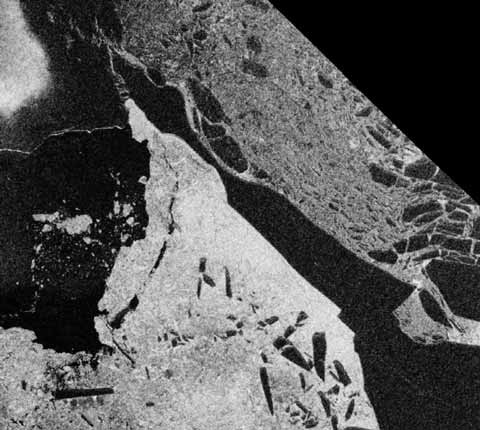
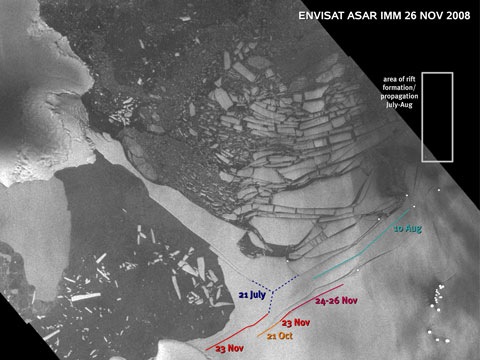 According to Alister Doyle, Reuters’ man in Antarctica (now that’s a job I’d like to try…), what’s left of the Wilkins Ice Shelf is on “the brink of collapse with just a sliver of ice holding it in place“. Earlier this week, Doyle