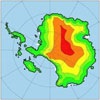
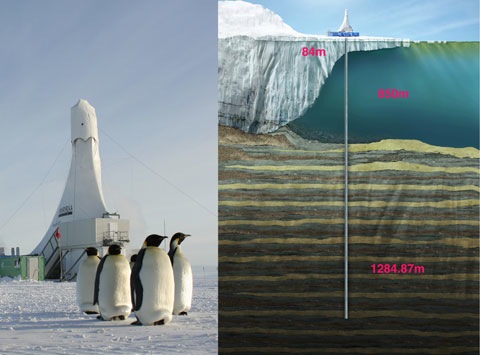
 The last time that atmospheric CO2 levels were as high as today, the West Antarctic Ice Sheet (WAIS) regularly retreated or collapsed, causing sea level rises of up to 7 metres according to the first analysis of the first ANDRILL core, published in Nature today. The ANDRILL (Antarctic Geological Drilling) programme, a joint effort by scientists from New Zealand, Italy, the USA and Germany, drilled a 1,280 metre core from the seabed under the Ross Ice Shelf. It’s the longest and most complete drill core recovered from Antarctica, and was made possible by drilling technology developed by a team at the Antarctic Research Centre at Victoria University of Wellington led by Alex Pyne.
The two Nature papers [1. Obliquity-paced Pliocene West Antarctic ice sheet oscillations, Naish et al, Nature, 19 March 2009 doi:10.1038/nature07867, and Modelling West Antarctic ice sheet growth and collapse through the past five million years, Pollard and DeConto, doi:10.1038/nature07809] focus on the “warm Pliocene” between two and five million years ago when CO2 levels were around 400 ppm. This is considered a good analogue for where our climate is headed, and the consequence, according to Professor Tim Naish of VUW, joint science head of ANDRILL, is that if we reach 550 ppm CO2 and a resulting 3ºC increase in global temperature, then large parts of the WAIS could melt on timescales of the order of centuries, and be completely gone within a thousand years.
The ANDRILL core documents 38 advances and retreats of the ice sheet, and suggests that during the warm Pliocene the key driver could have been the “obliquity” cycle in the earth’s orbit around the sun — a 40,000 year tilt in the Earth’s axis towards and away from the sun that affects the length of summers at the poles. New modelling of the ice sheet[2. Pollard & DeConto] confirms the link with the obliquity cycle, and suggests that the primary mechanism is melting of the base of the ice sheet by warm oceanic waters — a process that has already started.
In other WAIS news, a British team reports on the success of their robot submarine, Autosub, which made voyages of up to 110km under the Pine Island Glacier ice shelf, recording temperature and salinity, and providing valuable data about melting at the glacier grounding line.
More coverage: Nature commentary by Phillipe Huybrechts, Science Daily, the Telegraph, AP and Reuters.
[Pulp]

 Carbonscape, the New Zealand company working on making charcoal from a microwaving process discussed here and here on Hot Topic, has just announced that they are one of only five companies to make the shortlist in a global competition, the Financial Times’ Climate Change Challenge.
 Muriel Newman, former ACT MP and doyenne of the libertarian right in NZ, has finally returned from New York where her NZ CPR was one of the “sponsors” of the
  Gerrit van der Lingen, a local crank, NZ CSC member and self-styled “climate change consultant” who