
Bob’s big lie

homer.jpgTime to revisit events at crank central. In the course of researching the NIPCC (at the behest of Peter Dunne), I popped over to the International Climate Science Coalition site, and then on to their Australian spin-off. The Aussie crank collective is greatly enriched by the presence of Prof Bob Carter, known here as “the great communicator” because of his accomplished presentation skills and ability to make outrageous nonsense sound almost plausible. The ACSC points to Prof Bob’s latest article for Aussie magazine Quadrant, and so — noting that one R M Carter is due to give evidence to the ETS Review committee at some point — I thought I ought to catch up on the great man’s current thinking. Prepare yourself for a jaw/desk interface event:

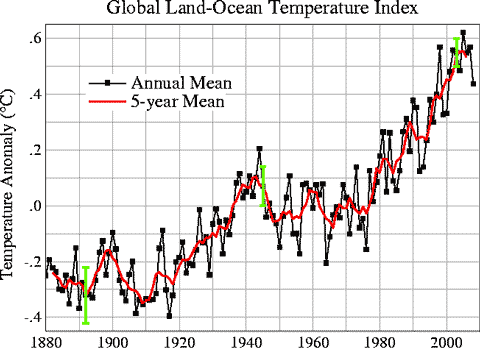
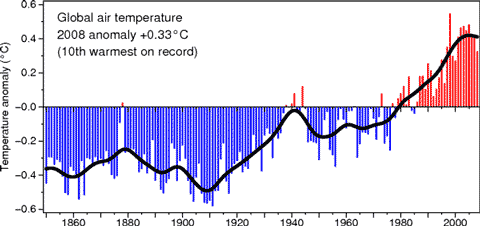
Get this. First, there has been no recent global warming in the common meaning of the term, for world average temperature has cooled for the last ten years. Furthermore, since 1940 the earth has warmed for nineteen years and cooled for forty-nine, the overall result being that global average temperature is now about the same as it was in 1940.

Global average temperature is now “about the same” as it was 69 years ago? Obviously, the “cooling since 1998” lie no longer cuts the mustard. Bob has to bend the facts beyond breaking point to bolster his case. Here’s the NASA GISS graph:
GISS409.gif

And here’s the Hadley Centre version:
Hadley409.gif

It is quite clear that global temperature is only “about the same as 1940” for definitions of “about the same” that consider variations ±0.5ºC to be inconsequential. You might as well say that because the world hasn’t warmed by 10ºC then it hasn’t warmed at all. But if you do that, then you can’t also insist that the world has cooled since 1998…

And how on Earth (or off it), did Research Professor Robert Carter of the James Cook University (Queensland) and the University of Adelaide work out that the world has warmed for 19 years but cooled for 49 since 1940? He must have a sophisticated statistical analysis to bring to bear on the topic. Or perhaps he has been counting all the little ups and downs in the GISS graph… Great science, by a great… something or other.

Don’t look back in anger

cindy.jpgWith the Bonn meeting over and a huge amount of negotiating still to do, Hot Topic’s woman at the table, Cindy Baxter, gives her impression of the state of play — and she’s not a happy bunny…
I’m getting angry now.

I’ve just spent nearly two weeks in Bonn watching the train wreck of the climate negotiations as delegations stuck in their corners, most especially the officials from the industrialised world.

At one point, in a developing country move led by the Alliance of Small Island States (AOSIS), there was some great draft text for the Kyoto Protocol parties — calling for developed countries to cut emissions by an aggregate of at least 45% by 2020 which might (might) keep the carbon loading in the atmosphere below 350 ppm. Might I say because even that’s not for sure at all. The text was supported by almost every member of the 130-strong developing country “G77” + China, with the notable exception of a few OPEC countries. It simply “noted” that this was what had to be done – and that figures like this need to be on the table.

But in the end even this note went west, with the NZ delegation joining the fight against it, and the result was agreement to discuss the developed country aggregate target next time, in June. Erm, that’s what they were supposed to do this time. So much for our concern in this part of the world for our pacific neighbours.

The only real numbers in the entire meeting were the calculations on the current aggregate 2020 target, based on submissions or announcements made by the developed world to date. Greenpeace crunched the figures and it wasn’t pretty. 4% to 14% by 2020 at 1990 levels. That’s it. Pathetic. New Zealand, of course, didn’t have any targets at all to contribute to the table, but you can rest assured it would fall in the lower half.

New Zealand kept bleating about its problems — I had a conversation with one NZ delegate who was terribly pleased with himself about the adoption of a 450 ppm carbon loading limit. What, I asked, would NZ do to keep us to this? Certainly removing any reference to a strong aggregate target would be counterproductive to that. He went into a rant about how the whole world has to act together. The old “you first” charade. Never mind that the western world is historical responsibility for causing this problem in the first place.

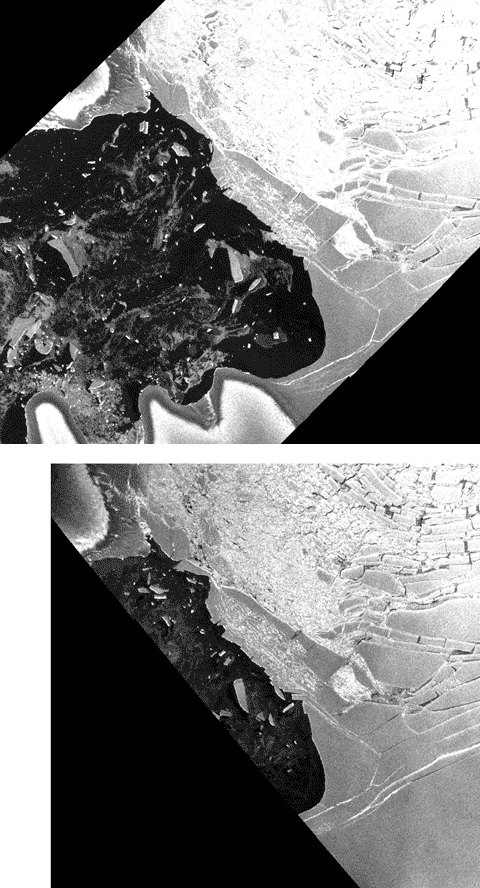
What has to happen to move it forward? Clearly massive ice shelf break ups in the Antarctic won’t do it. We need real leadership and it ain’t gonna come from our lot, any time soon. These officials, who’ll all be back in Bonn in 6 weeks time, need very clear direction from their bosses, from the world’s leaders.

Obama wants an end to our dependence on fossil fuels. That sort of statement is a good start — although the weirdness of the US system means that he can’t introduce his own legislation and has to rely on a difficult congress to make it happen. As Alden Meyer of the Union of Concerned scientists told journalists one day at a press conference “let’s call the US target a moving target. And it’s moving in the right direction.”

Leaders have to step up and direct these officials to move — and move faster. We can’t glue the Wilkins ice shelf back on. We can’t make it rain in Australia, or anywhere else for that matter. But we can change the politics. These guys need to feel the heat. Otherwise we all will.

[Oasis]

Geoengineering on the table

Lacknertrees.jpg

John Holdren, recently confirmed as President Obama’s science adviser, has said in an interview that discussions at the White House include looking at geoengineering options to reduce the effects of global warming. He stressed that it would be a last resort, but can’t be ruled out of discussion if the failure to cut greenhouse gas emissions continues. He is concerned that several tipping points could be fast approaching, with chances of “really intolerable consequences”, instancing the possible loss of Arctic summer sea ice within six years, the release of frozen methane from thawing permafrost in Siberia, and more and bigger wildfires worldwide. He would much prefer to see the problem solved by reducing emissions of greenhouse gases, but global warming is happening so fast that geoengineering has to be looked at. “We don’t have the luxury … of ruling any approach off the table.”

Continue reading “Geoengineering on the table”

Do you remember the first time?

NZETS.jpgThere’s a first time for everything, and today it was making an oral submission to a parliamentary committee — the ETS Review committee. I made my written submission public a while ago, so I won’t repeat that here, but in my 15 minute slot (5 mins for initial presentation, 10 mins for questions), I chose to emphasise four key points:
  • That the effects of climate change are being observed now, ahead of expectations. I quoted from the recent Copenhagen conference closing statement in support: For many key parameters, the climate system is already moving beyond the patterns of natural variability within which our society and economy have developed and thrived. These parameters include global mean surface temperature, sea-level rise, ocean and ice sheet dynamics, ocean acidification, and extreme climatic events. There is a significant risk that many of the trends will accelerate, leading to an increasing risk of abrupt or irreversible climatic shifts.
  • That the emissions reductions New Zealand will have to make are likely to be much steeper than currently envisaged, because the science is beginning to suggest we need to move beyond stabilisation of GHG levels into active sequestration (I mentioned Hansen and 350 ppm), and because simple equity demands that the developed world adopts a “cap and converge” approach to emissions in order to engage China and India.
  • That the climate commitment — the fact that we have 20 to 30 years of warming in the pipeline whatever we do means that New Zealand has place considerable emphasis on adaptation. We need to build resilience to the direct impacts of climate change here (which with luck won’t be too bad), and to the actions that other countries take to address change (counter food miles arguments and so on).
  • Finally, that early action on reducing emissions would be significantly less costly than making drastic forced changes later.

I closed by reiterating my first recommendation: that the government should seek to build a consensus of business and consumer interests on both the need for action, and the direction to be followed.

The questions were interesting. Charles Chauvel, Labour’s climate spokesman, asked me to elaborate on the matter of targets. John Boscawen (ACT) commented that my evidence flatly contradicted the previous submitter, Dr Bruce McCabe (which appears to have been along the lines of “cooling since…”), and asked if I would examine that evidence and explain to him why it was wrong. Peter Dunne asked me to do that on behalf of the whole committee, and I happily agreed. Should be an interesting exercise… 😉 Jeanette Fitzsimons (Green) then asked me to explain the significance (if any) of 8 year trends in climate data — obviously making a point to Boscawen. Finally, Nicky Wagner (National) asked me to elaborate a little on why regulatory action was required to complement the emissions trading scheme: I mentioned efficiency measures.

Looking at the full list of submitters the committee is hearing (available at Carbon News), it’s clear that more than a few of the usual crank suspects have got through: Bryan Leyland’s there, as is Vincent Gray and the NZ CSC. Plenty of debunking to come, as their submissions are made public… 😉

[Pulp]

Breakaway

Wilkinsbreaakup90408.gif

This somewhat crude(*), but effective animation of the two most recent ESA images of the Wilkins Ice Shelf break up shows clearly that with the “pin” gone, large areas of ice are beginning to move. The most recent image (April 8th) is the smaller, overlaid on one captured on April 5th. Focus on what was the narrowest part of the ice “bridge” to Charcot Island, and you can see a large berg rotating counterclockwise, while the mass of shattered ice at the original break up site and three big bergs to the east appear to be moving slowly north. To the NE of the base of the “bridge”, cracks are getting wider, while there’s also substantial northward movement in the big bergs to the north and east left by earlier collapses. It’s not clear from this pair of images what’s going on in the biggest cracks running SW/NE below the base of the “bridge”, but that will be the region to watch for the next big breaks.

[* What do you expect? GR fecit…]