 Back in March climate change minister Nick Smith decided it was time to sort out whether the Emissions Trading Scheme was a recipe for economic disaster, as ACT and big emitters were insisting (using figures from a shonky report by NZIER), or affordable, as Treasury modelling (conducted by Infometrics) showed. Smith commissioned both economic consultancies to work together to arrive at a consensus, which they were happy to do (at a cost of $79,200 + GST). The result of this ministerial banging of heads was released yesterday [PDF], and it is simultaneously interesting, encouraging and profoundly disappointing.
“Widespread climate-related impacts are occurring now and are expected to increase”
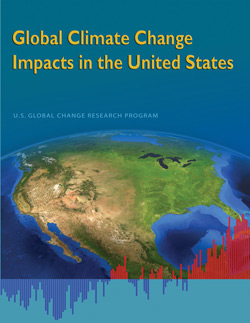 I think I was around eleven years old when I last thought it would be good to be an American. But I admit to a small twinge of envy as I read the report released yesterday by the Administration:  Global Climate Change Impacts in the United States.  This is a scientific report, backed by the government, telling the general public what is now known of global warming and what it will mean for the US. The sort of thing one would have thought is a core function of democratic government. Meanwhile in New Zealand a select committee is required to solemnly consider submissions from climate science deniers, a PM wants us to be ready in case the science deteriorates and the sceptics are right, and a leading climate scientist is sacked for what sound like trivial offences against management policy.
Start me up
[youtube]ro0-7U8UtvI[/youtube]
Above: a new animation of Arctic sea ice from 2000 to May 2009, from the Alfred Wegener Institute for Polar and Marine Research and KlimaCampus of the University of Hamburg in Germany. It accompanies their first contribution to this year’s sea ice forecasts — and they put the odds of a new record minimum at either 28%, or with an enhanced model that takes better account of current ice conditions about 49%. Close enough to my gut feeling of 50/50 to allow me a little confirmation bias, I think… The press release is here, and the full forecast here (pdf). The AWI modelling is part of the Search forecasting exercise I mentioned last week. The full set of forecasts should be out in the next week to ten days, according to project co-ordinator Jim Overland, and I’ll cover them when they become available.
Heatstroke
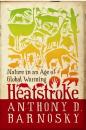
Anthony Barnosky is a Berkeley University paleoecologist deeply concerned about what lies ahead for Earth’s ecological systems if we persist in heating the globe. His recently published book Heatstroke: Nature in an Age of Global Warming explains his concerns. Global warming with its own method of ecosystem demolition has joined the three other factors — habitat loss, introduced species and population growth — by which human activity has impacted badly on ecologies.
Yes, climates have changed in the past and species and ecologies have changed with them. Many scales of climate change have occurred, from slow tectonic to the fast changes embedded within glacial and inter-glacial times. Why should an ecologist worry about today’s global warming which is just one more scale? Barnosky has two reasons: one is the rate of change, which is way faster than anything in the past, the other is that the new climate will be hotter than that in which homo sapiens and many other animal species evolved.
Barnosky’s book is packed with examples of what is already happening and what it points to. As the climate warms many species already have to move to survive. He quotes the result of one survey which showed a set of 99 species of birds, butterflies and alpine herbs which within ten years had shifted on average 6.1 kilometres poleward or 6.1 metres upward in elevation. Dying out on mountain tops is the fate or likely fate of the latter. He traces many other factors, such as the subtle interactions between climate, vegetation, and reproductive success for species such as reindeer, or the change of climate conditions to favour the fungus which kills harlequin frogs – in the tropical mountains of Central America they are now dying in unprecedented numbers because of this new interaction between species. Synchronisations which have served some species well are no longer able to be relied on – marmots in the Colorado Rockies are coming out of hibernation earlier, but heavier snow is taking longer to melt and the green shoots the emaciated marmots need to feed on are not ready. In the ocean he details many instances of marine ecosystems under serious stress from the double whammy of traditional human impacts such as pollution and overfishing now followed by global warming. Corals are a clear example.
Yosemite and Yellowstone National Parks, Kruger Park in Africa and Tambopata Nature Reserve in Peru, are among places Barnosky selects for closer attention. Small mammal species in Yosemite have changed how they live in the park, in a way that indicates some may be on the way out. Amphibians in Yellowstone are in decline. In Kruger between 13 and 20 of the 87 mammal species there today are projected to disappear by 2080. The Tambopata rainforest, along with many rainforests throughout tropical South America, has a 75% chance of being mostly savannah by 2080.
Barnosky devotes a fascinating chapter to what began as his big moment of realisation in a deep cave in the Colorado mountains in 1985. That moment turned into a fifteen year project for four large institutions, more than two dozen scientists and hundreds of volunteers. They retrieved thousands of fossils deposited over nearly a million years by bushy-tailed wood rats who have the convenient habit of collecting odd objects they find lying around and bring them back to their nests. Among their favourite items are bones, some of them encased in the pellets regurgitated by birds or defecated by carnivores. In the eight feet of excavated layers in that cave was an invaluable record of the changing makeup of local species through the climate changes of the Pleistocene. The story of how the various layers were interpreted and dated is another of those intricate detective operations which mark the scientific interpretation of so many of the clues from the past still embedded in discoverable form.
Barnosky is always considered in his appraisals. He gives due weight to the resilience of ecologies, and nowhere rushes to judgment. But he thinks we are in a time of accelerated extinction of species, and warns that it could be very large indeed. There were already pressures enough driving us towards dwindling biodiversity. Global warming increases greatly the speed of the train on its way to mass extinction.
A sober chapter discusses the possibility of climate change acting as a selective force to stimulate the building of new species. In the past, times of slow climate change seem to correlate with bursts of speciation. But Barnosky points out that climate change today is at a rate which outpaces mutation rates of most animal and and plant species by a far greater margin than we have ever seen. Recombination within gene pools offers some possibility of evolutionary change, but it is limited without sufficient mutation. At the end of this discussion, engrossing for any lay reader with an interest in evolutionary processes, he concludes: “Global warming is not only doing its part to diminish biodiversity substantially within a century or so, it is also limiting the future evolutionary potential of Earth.”
Barnosky nevertheless insists on hope. His final chapter centres not only on slowing down global warming but also on a programme for wilderness protection. First we need to keep what we already have – the 12% of Earth’s surface now protected in some fashion to preserve nature. Second, climate-connection corridors must be provided for species movement. Third, new initiatives are required to minimize high-impact human land use, to create marine-based reserves before it is too late, and to consider the conceptual division of reserves into two functions – one kind devoted to the preservation of individual species and certain assemblages of species, the other devoted to the preservation of wilderness.
The alternative for humanity is the technological “termite-life” of ecological loss.
Barnosky writes with an easy style, combining clarity with a near-conversational level of communication with the reader. His book offers many insights into the nature of ecological communities and why it is that they matter so deeply. It is also further evidence if we need it of how profound the effects of anthropogenic global warming are set to be if we do not change our ways.
Southern freeze
 While we’re on the subject of ice, Australia’s Antarctic Climate & Ecosystem Cooperative Research Centre today launched two new publications: Polar ice sheets and climate change: global impacts [PDF], and Changes to Antarctic sea ice: impacts [PDF]. Described as “position analyses”, the papers provide an excellent overview of the current state of our understanding of ice sheets and how they’re behaving in a warming climate and the way Antarctic sea ice is responding to climate change.