
 The fourth section of the Copenhagen congress synthesis report is firmly in the realm of policy. Addressing climate change involves ethics.  Unequivocally the report asserts that serious equity issues should inform the fight to restrain global warming and enters into detail in identifying them.  For one thing the climate is not changing uniformly around the world and the human effects are unequal. Profoundly unequal, for example, in the impacts of climate change on health. The poor, the marginal, the uneducated and the geographically vulnerable are at greatest risk of injury and death. In general, developed countries are most responsible for climate change up to now while developing countries suffer the majority of the impacts. Any lasting and widely accepted solution to the climate change challenge should recognise and account for these equity dimensions in negotiations and agreements.
Hit the road, Nick
 Climate minister Nick Smith and international negotiator Tim Groser have published the schedule for their recently announced consultation exercise on a 2020 emissions target for New Zealand. The hastily arranged exercise (announced only last month, and a surprise to many) has already drawn calls for an interim target of 40% by 2020 from the recently-formed NZ Climate Action Partnership and Greenpeace. In an interesting development, Carbon News is reporting that Green Party climate change spokeswoman Jeanette Fitzsimons has floated the idea that NZ could adopt a split target — setting separate 2020 targets for carbon dioxide, nitrous oxide and methane:
Fitzsimons says that with the technology not yet available to reduce methane emissions from farmed animals – responsible for half of New Zealand’s total greenhouse gas emissions – this country should be thinking about setting separate targets for carbon, nitrous oxide and methane for 2020.
“If we set an overall target that is mainly determined by the difficulty of reducing agricultural emissions, it looks to the rest of the world like we are doing nothing,†she said.
It’s an interesting concept, at the very least, though I have to say I’m not keen on giving agriculture a wholly free ride. Federated Farmers like to insist that the “technology is not available”, but there are a range of options farms can use to reduce emissions, from the use of nitrification inhibitors to better handling of manure (not to mention shifting to low-carbon crops or carbon farming).
Full details of the public meetings below the fold. I’ll be making an effort to attend the Christchurch meeting next Wednesday evening.
TV3 needs to take stock
 TV3 news hit one of its lows last night. Reporter and presenter Samantha Hayes was in Aitutaki in the Cook Islands for the visit of Greenpeace’s ship the Esmeralda on its Pacific climate impact tour, with Sign On ambassador Keisha Castle Hughes on board [Greenpeace release]. I was watching the news item with interest when I thought I heard the reporter saying “while the science is far from settled…â€. Since my hearing is not reliable I checked on the TV3 news website. I had heard aright. Here is the full sentence: “While the science is far from settled, Greenpeace is convinced that Aitutaki is on the front line of climate change.â€
Copenhagen 3: targets and timetables
The third section of the Copenhagen congress synthesis report considers the global targets and timetables that will be necessary to keep warming to no more than 2 degrees. The report acknowledges that 2 degrees introduces considerable risk to human society and natural ecosystems. However global average temperature has already risen by 0.7 degrees, and inertia in the climate system makes 1.4 degrees inevitable. So 2 degrees may be the best we can hope for.
Gone too soon
 The June Sea Ice Outlook forecasts for the Arctic sea ice September minimum extent have been released today by SEARCH. Most groups are picking a minimum close to last year’s 4.7m km2, but the melt season is starting with an unusually small amount of multi-year ice. The report suggests that there is “a small but important probability of a major sea ice loss event this year, given that the ice is thinner and younger than previous years, combined with a possibility of atmospheric conditions that cause significant ice retreat.” The full range of forecasts is shown in this chart:
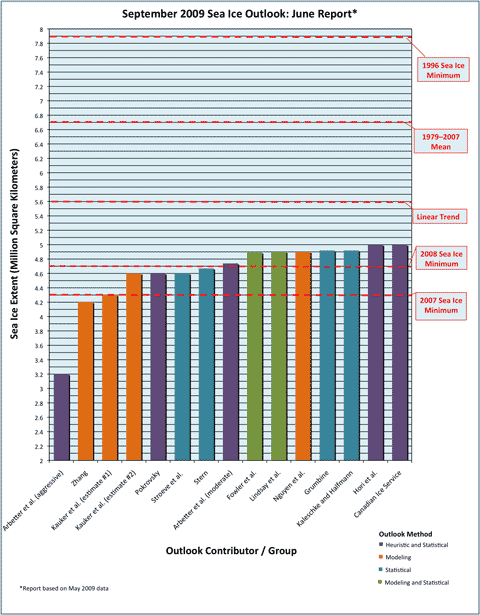
The range of individual outlook values is from 4.2 to 5.0 million square kilometers. All estimates are well below the 1979–2007 September climatological mean value of 6.7 million square kilometers. Half of the responses are in the range of 4.9–5.0 million square kilometers; the remaining estimates are in the range of 4.2–4.7 (Figure 1, above). The uncertainty / error values, from those groups that provided them, are close to 0.5 million square kilometers, thus many of the values overlap.
Interestingly, the forecasts showing the lowest minima are based on sea ice modelling driven by atmospheric forcings and initialised with current sea ice conditions. The projection by Jinlun Zhang (next to lowest in the chart) suggests that even with conditions like last year — that is, without the Transpolar Express of warm southerlies that set up in 2007 — the 2007 record could fall. On the other hand, a Russian scientist suggest thats Pacific sea surface temps could be priming a cooler pattern than last year.
The full report [PDF] is a very interesting read for all ice watchers (and gamblers). On this guide to the form, it looks as though I’ll lose my bets – but the weather over the next two months will be the deciding factor. Do I feel lucky…?