What’s the world got in store (first reprise)

A book based on the proceedings (or a good chunk of them) of last year’s Managing the unavoidable conference on climate change adaptation in New Zealand are now available online as Climate Change Adaptation in New Zealand: Future scenarios and some sectoral perspectives from the NZ Climate Change Centre. Not the snappiest of titles, but there’s a lot of interesting stuff included: I’m particularly looking forward to reading McGlone et al’s chapter on Climate change, natural systems and their conservation in NZ [pdf], Gavin Kenny on building resilience in east coast farming systems [pdf], as well as the chapters on risk management and the scenario development that preceded the conference. The NZ Climate Change Centre were kind enough to send me a couple of printed copies (one’s winging its way to Bryan as I write), but pdf versions of the contents are available for download. Recommended.

Meanwhile, the Climate Change Centre has redesigned its web site, and is planning to offer an NZ climate FAQ sometime soon. The Centre is also planning to build a list of local climate experts who will be available to respond to questions about climate issues affecting NZ. I’ll be keeping an eye on developments…

All guns blazing

I well remember a meeting of the Hamilton group of Amnesty International back in the 1990s, when a visitor who lived in the Maldives turned up, wanting to find out more about how AI worked. It wasn’t long before we found out why he was interested, as he told us the story of repression and out-of-sight political prisoners in his country.

One of those prisoners was Mohamed Nasheed, whose party won an election in 2008, ending the 30 years dictatorship which preceded it. He is now President of the Republic of Maldives. It was no easy path to the presidency. His several imprisonments added up to a total of six years, 18 months of which were spent in solitary confinement. And it’s no easier now that he is there. The Maldives, comprising numerous coral islands, is the lowest country in the world, with a maximum natural ground level of only 2.3 metres, with the average being only 1.5 metres above sea level. Its vulnerability to climate change is obvious. It’s certainly obvious to Nasheed, and he’s not taking it lying down, as he made very clear in his blog written last year before the Copenhagen conference:


“No one in the Maldives is applauding the recent pledge of the G8 nations to try and hold temperature increases to 2 degrees and the atmospheric concentration of CO2 to 450 parts per million. A few years ago, those might have been laudable goals, but new science makes clear they’re out of date…

“In January 2008, James Hansen, one of the world’s leading climatologists, published a series of papers showing that the actual safe limit for carbon in the atmosphere was at most 350 parts per million. Anything higher than that limit, warns Hansen, could seed ‘irreversible, catastrophic effects’ on a global scale…

“For the Maldives, climate change is no vague or distant irritation but a clear and present danger to our survival. But the Maldives is no special case; simply the canary in the world’s coal mine. Neighboring Asian countries like Bangladesh are already suffering from saltwater intrusion as seas rise; Australia and the American southwest are enduring epic drought; forests across western North America are succumbing to pests multiplying in the growing heat. And all of this is with temperature increases of nearly 1 degree — why on earth would we be aiming for 2 degrees?”

He has recently appeared — via video link — at the Hay Festival in the UK. The Guardian’s accounts here and here were enthusiastic.

Appearing  by live video link, Nasheed showed more life and animation in 2D than any of the politicians currently wandering around the site (there’s a lot of former Labour ministers with time on their hands these days) usually manage in the flesh. Where our MPs duck and dive and try to say as little as possible that might upset anyone, Nasheed went in with all guns blazing.

Ed Miliband interviewed Nasheed.  There were several points where his sense of the urgency of the issue was very apparent. When asked about educating people about climate change he declared it is too late for that.

“What we really need is a huge social 60s-style catalystic, dynamic street action. If the people in the US wish to change, it can happen. In the 60s and 70s, they’ve done that.”

But he also expressed uncertainty about the US, considering China and India actually far more receptive to the concept of climate change.

“My sense of China is that they tend to believe in climate change. My sense of the US is that a fair amount of them simply don’t believe in it.”

He noted how, unlike the developed world, India listened to small countries’ fears over the issue. “The refreshing thing about India is they listen to people, certainly they listen to the Maldives.

Nasheed said countries committed to tackling climate change should press ahead with agreements and emissions reductions regardless of whether they took more recalcitrant nations with them.

“We cannot wait for the lowest common denominator where everyone agrees to doing almost nothing.”

He’s not waiting, like New Zealand, for others to take the lead. The Maldives is embarking on a programme to become the first carbon-neutral country within 10 years. It has three large wind farms under construction and photovoltaic technologies are being developed, although the country is also having to build sea walls to repel the ocean and energy-hungry desalination plants to replace fresh water supplies lost to the sea.

It might look like hoping against hope, but this was his conclusion:

“I believe in human ingenuity. We are not doomed. We can succeed and we must work along those lines.”

Brave words, though there must be times when they become difficult to say.  The Maldives lives on the edge of a slow disaster. We can be grateful for the clarity and persistence with which Nasheed and others like him keep drawing attention to what is happening. But the forces of denial in rich countries are not yet exhausted. Few politicians in power in those countries are willing to speak with like clarity to their populations, and denialist bluster still holds considerable sway among legislators. Nasheed’s concern that the US is not yet ready to face reality is well founded. It is by no means clear that we will act in time to save the Maldives from the ravages of a rising sea.

Note: There’s a short video clip here from the UN Environment Programme in which Nasheed sets out his concerns in very reasonable terms which are his trademark.  This Al Jazeera interview covers more specific ground. I liked his statement in the course of it: “Leaders cannot afford the luxury of ignorance.

Whose lie is it anyway? Easterbrook caught red-handed

Don Easterbrook was forthright in his attempt to rebut my discovery that he had used an edited version of a graph of Holocene temperatures originally prepared by Global Warming Art in his recent Heartland conference presentation. He accused me of telling a “dispicable” lie, amongst other things:

The charge by ‘the truffle grower’ that I used a graph “prepared by Global Warming Art” and that I “altered it to fraudulently bolster his case” is an outright, contemptible lie. I have the entire Greenland oxygen isotope data in my computer and use it extensively to plot data, so why would I use anything else? The data I use has never been altered in any way.

Unfortunately for Easterbrook, his own web site contains material that proves he is the one telling “outright, contemptible” lies, and defaming me in the process. Here’s why…

Continue reading “Whose lie is it anyway? Easterbrook caught red-handed”

It’s as simple as that

As a former English teacher I naturally take pleasure from the presence of literary people in the battle for action on climate change. Andy Revkin’s DotEarth blog drew my attention to one this week.  He’s the Norwegian novelist Jostein Gaarder, the famed author of the novel Sophie’s World which since publication in 1995 has run to an extraordinary sales figure of 30 million copies worldwide, in 53 different languages. Taking a teenage girl through a discovery of the history of philosophy hardly seems the stuff of best-selling fiction, but it was in his case. And if you’re wondering what an author does with all that money, one of the uses it has been put to is the setting up of an annual US$100,000 international environment and development prize, the Sophie Prize. This year it has been awarded to climatologist James Hansen. “He receives the award for his clear communication of the threat posed by climate change and for his genuine commitment to future generations.”

Gaarder was invited as one of the speakers at a panel on global warming at this year’s PEN World Voices Festival, at which Revkin also spoke. The participants were asked to respond to the question “What can we do about climate change?”  Revkin commented that Gaarder stole the show in his “impassioned, humorous and biting talk’.

Continue reading “It’s as simple as that”

Cooling-gate: the 100 years of warming Easterbrook wants you to ignore

Evidence that Don Easterbrook did more than misrepresent and alter a graph in order to remove evidence of recent warming in his presentation to the recent Heartland “climate conference” is beginning to emerge. It now appears that he has been misusing one of the most important paleoclimate temperature data series, compiled from the GISP2 Greenland ice core, effectively hiding a full 100 years of recent warming. His “rebuttal” of my revelations that he had misused a graph from Global Warming Art includes this assertion:

…below is the Greenland data for the past 10,000 years (Holocene) from the published paper by Cuffy and Clow (1997), two distinguished US scientists. Note that temperatures for almost all of the past 10,000 years have been warmer than present.

In my post yesterday, I suggested (on the basis of the notes accompanying the raw δ18O data), that the “present” Easterbrook was referring to was 1950. It now appears I was being far too generous. Thanks to a bit of detective work by MartinM in the comments to that post, the data set used by Easterbrook to draw his version of a Holocene temperature graph turns out to be the temperature series derived from the δ18O data by Richard Alley: Alley, R.B. 2004. GISP2 Ice Core Temperature and Accumulation Data. IGBP PAGES/World Data Center for Paleoclimatology
Data Contribution Series #2004-013. NOAA/NGDC Paleoclimatology Program, Boulder CO, USA
(ftp download here). The most recent temperature data point in that series is 1905, and that’s the point Easterbrook labels as the present. To make his case he has to make a full century’s worth of warming disappear.


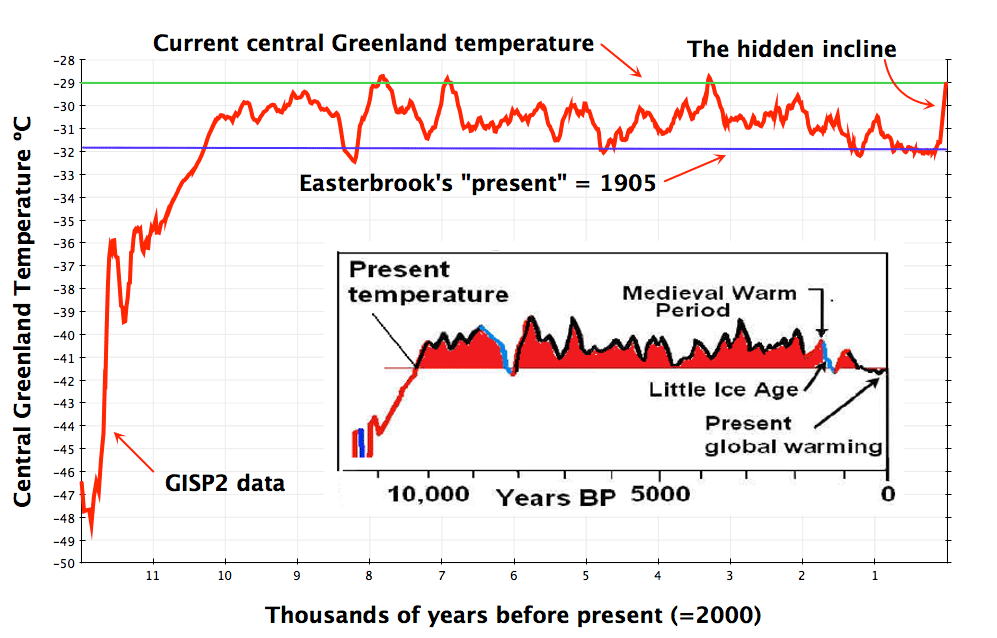
I downloaded Alley’s data and plotted it with my new favourite graphing tool. This is what it looks like:

GISP2graph

I’ve inset the graph from Easterbrook’s “rebuttal”, and added a couple of helpful lines (click for a bigger version). I think it’s pretty clear that the data behind both graphs is the same. There’s more detail in my plot, but the key features are all in the right places. I’ve added a blue line to represent Easterbrook’s “present temperature”. The green line represents an estimate of current temperatures in central Greenland. I looked at the nearest station with a 100+ year record in the GISS database (Angmagssalik), and used a Mk 1 eyeball to estimate a 2.5ºC increase over the century (I’d welcome a more accurate estimate, if anyone’s prepared to dig one up). The difference between the green and blue lines is the warming that Easterbrook wants to ignore. His statement that temperatures for almost all of the past 10,000 years have been warmer than present is shown to be complete nonsense. There are three points in the last 10,000 years when temperatures high up on the Greenland ice sheet were similar to today, but by no stretch of anyone’s imagination can it be said to have been warmer for most of the time. The incline he’s trying to hide is one of the largest and steepest in the last ten millenia…

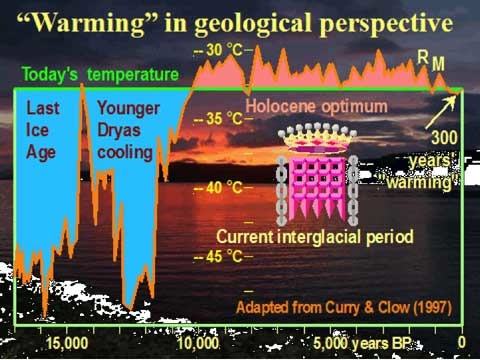
The same temperature series also appears to form the basis for Monckton’s famous “Curry & Clow” slide from early 2009:

Monckton credits the wrong people, of course, but adds a helpful “300 years of warming” arrow. Like Easterbrook, he omits the last 100 years of warming. This is what he said at the time:

Seen in the geological perspective of the last 17,000 years, the 300 years of recent warming, nearly all of which must have been natural, for we could not have had any significant influence except in the past 25 years, are manifestly insignificant.

The 300 years of recent warming are of course the 300 years up to 1905. What has happened since then is manifestly significant. This sort of misdirection is par for the course for Monckton, but what about Easterbrook?

If he knowingly misrepresented 1905 as the “present” (and given that he claims to have “the entire Greenland oxygen isotope data in my computer and use it extensively to plot data” that has to be a real possibility), then he is clearly misusing the data and misleading his audience. The intellectual dishonesty involved is breathtaking. His audience may want to be mislead, but that is irrelevant. On the other hand if, as a distinguished academic with a long career studying (amongst other things) glaciers and climate change, he really doesn’t know that the data series stops in 1905, then he is demonstrating ignorance of a sort that would embarrass any student.

So where’s the investigation of this academic fraud? Where are the hordes of bloggers and journalists screaming blue murder about the manipulation of data to tell a convenient story? Here’s Joseph Bast, president of the Heartland Institute, writing about the so-called “climategate” affair last November:

Looking at how past disclosures of fraud in the global warming debate have been dismissed or ignored by the mainstream media leads me to suspect they will try to sweep this, too, under the rug. But thanks to the Internet, millions of people will be able to read the emails themselves and make up their own minds. This incident, then, will not be forgotten. The journalists who attempt to spin it away and the politicians who try to ignore it will further damage their own credibility, and perhaps see their careers shortened as a consequence.

How very true. I look forward to Bast issuing a statement apologising for being a party to Easterbrook’s fraud, for providing him with a platform to mislead and misinform, and instituting an in-depth investigation into the background of Cooling-gate. But I suspect he will be doing his best to ignore the whole affair. I leave it to the reader to decide what that does for the credibility of Bast, Heartland, and the scientists who shared a stage with Easterbrook at Heartland’s Chicago conference.

[Update 29/5: My graph revised and improved, see comment below]