
Ask me why

Sadly the Greenhouse Policy Coalition (GPC) welcomes the result of the poll they commissioned from UMR Research, as reported today in the Herald.  I’ll comment on the poll a little later in the post, but first a reminder of what the GPC stands for. It includes some of the largest emitters of greenhouse gases in its membershipwhich it describes as “a large and diverse range of New Zealand industry and sector groups covering the aluminium, steel, forestry (including pulp and paper), coal, dairy processing and gas sectors.”   They are described as responsible for 14% of GDP and 31% of total exports.

Note they do not deny the reality of human-caused climate change:

“The Coalition accepts there is growing evidence of a causal connection between observed changes in the global climate and human-induced emissions of greenhouse gases.  The Coalition considers there is sufficient scientific evidence to warrant the adoption of appropriate precautionary public policy measures.”

But their notion of what constitutes appropriate measures is severely constrained by their determination to protect what they call the competitiveness of all sectors of NZ industry. They urge a wait and see attitude when it comes to doing anything of consequence to reduce NZ emissions.

“Climate change public policy should … be moderate and measured until such time as it is appropriate, and justified, to be otherwise.”


Current government policy seems to fit their bill pretty well. Although they would have preferred a suspension of the ETS they have welcomed the relief the revised scheme offered to large businesses.

Given the tepid policies being advanced by the government, the results of the commissioned poll are probably not surprising.  45.8 per cent think climate change is happening and is caused by humans – up 1.6 per cent from previously.  32.7 per cent think the climate is changing but are uncertain as to whether it is caused by humans – down 3 per cent. 19.3 per cent think the problem doesn’t exist – up 1.8 per cent.

But although 45.8 per cent think climate change is caused by humans only 36.3 per cent think it is a serious issue – down from 42.6 per cent last year. Generally speaking numbers were down on all measures aimed at mitigating climate change. For example, the 23.4 per cent of people who agreed New Zealand should reduce its emissions, even if it meant reducing the standard of living was 11 per cent down on last year’s 34.9 per cent.

Last year climate change concern was eighth in order of importance. This year it is tenth.

The GPC’s executive director, David Venables, said the results of the survey reinforced the Government’s decision to moderate the impact of the Emissions Trading Scheme and the need to fine-tune it to keep in step with New Zealand’s main trading partners – which lagged in implementing their own schemes – and the rest of the world.

In other words, in the court of public opinion the government is on the right track.

But can reasonable judgment be delivered by public opinion at the present? Public opinion is not being informed of the seriousness of climate change.  The majority of our political leadership displays little or no sign of concern at the mounting dangers of increasing greenhouse gas emissions. The message they thereby deliver to the public is that the issue is not of great importance. The public gratefully receives this message and turns its mind to more immediate concerns. Whereupon the likes of the GPC point to lack of public concern as a sign that the government has got it right. It’s not too difficult to see a mutual ratcheting down process proceeding happily between politicians and the public until the folly of it becomes too apparent to ignore. And heaven knows how far off that might be.

One has to hope it will be the ineluctable science which interrupts the process and not the onset of severe events. But I have been hoping that for a number of years now, and there is little sign of full appreciation of the science in the political sphere, in the media, or in the leadership of many major companies. From where is the general public able to receive the message if it is excluded from the mainstream of political and economic life?

Real understanding of the scientific evidence would mean that David Venables would lament the result of the poll. It would see John Key and Phil Goff standing alongside each other and saying this public ignorance was dangerous and they wanted to help correct it. Tomorrow’s editorials would declare the same. Some hope.

Meanwhile all the directly measurable effects continue – global temperature rises inexorably, Arctic summer sea ice diminishes with unexpected speed, ice sheets in Greenland and Antarctica continue to lose mass.  And the less specific predictions of increased wildfires, floods and droughts show every sign of coming to pass. Positive feedback loops loom in the shadows.

“Climate change public policy should … be moderate and measured until such time as it is appropriate, and justified, to be otherwise.” And when might that be, David Venables and all those for whom you speak?
[Fabs in Hamburg]

Double dipping: It’s grim up north #3

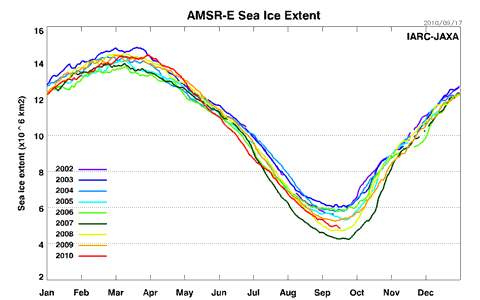
AMSRESIE100919.gif

Earlier this week, the National Snow and Ice Data Center (NSIDC) announced that the Arctic sea ice had reached its summer minimum extent, based on a four day run of extent increases. And then, like the fat lady in an overwrought opera refusing to die, trilling her agony and ecstasy to an appreciative audience, ice extent started dropping again. It was, as I suggested it might be at Neven’s Arctic Sea Ice blog, a double dip minimum — and as of this morning the extent (IJIS-JAXA graph above, but the NSIDC’s shows the same thing) is still dropping down towards 2008 — which holds second place in the record behind 2007. I still think it’s unlikely that the 2010 melt will do enough to pass 2008, but there’s a lot of thin ice and warm water up there, as I noted last Monday, and it will be interesting to see how the PIOMAS numbers for ice volume turn out — a new record low is definitely on the cards.

Attention will now turn to the autumn freeze-up, and the potential for the heat released by ice formation to impact northern hemisphere weather patterns. I’ve been reading a few papers on that subject, and will post a discussion as autumn up North progresses.

On a different tack, the future of the Arctic is becoming a popular subject for books. Robin McKie reviewed a selection for the Observer earlier this year (and from that selection I plan to read Charles Emmerson’s Future History of the Arctic, mainly because it seems to have arrived in southern hemisphere bookshops recently), but the book getting the most attention at the moment is Laurence C Smith’s The World in 2050: Four Forces Shaping Civilization’s Northern Future, due out this week (Science Daily). Smith summarises his vision in an article for the Wall Street Journal:

I imagine the high Arctic, in particular, will be rather like Nevada—a landscape nearly empty but with fast-growing towns. Its prime socioeconomic role in the 21st century will not be homestead haven but economic engine, shoveling gas, oil, minerals and fish into the gaping global maw.

That assumes, of course, that the “gaping maw” still exists…

People get ready

Britain needs to step up its efforts to prepare for unavoidable climate change, according to How well prepared is the UK for climate change? the first report of the Adaptation Sub-Committee of the Committee on Climate Change— the body established by the UK’s 2008 Climate Change Act to advise government on all aspects of climate-related policy. Committee chairman Lord John Krebs summarises the thrust of the report like this:

In brief, our headline finding is that whilst the UK has started to build capacity for adaptation through advice and information to a range of public and private sector organisations, there is little evidence that this is translating into tangible action on the ground in a systematic way.

The report identifies five key areas in which early action is required.


From the executive summary:

  1. Taking a strategic approach to land use planning – for example to (i) ensure that new buildings and infrastructure are sited in areas that minimise exposure to flood risk, do not increase flood risk to others, and do not create a legacy of flood defence or water supply costs; (ii) manage competing pressures on land – urban, natural and agricultural – in response to a changing climate; and (iii) enhance green space where effective in the design of towns and cities to help manage surface water drainage and cope with rising temperatures and heatwaves.
  2. Providing national infrastructure (energy, water, transport, waste and communications) – for example to ensure it can cope with rising temperatures; it is resilient to potential increases in certain extreme weather events, such as storms, floods and droughts; and it takes account of changing patterns of consumer demand in areas such as energy and water use, travel and consumption.
  3. Designing and renovating buildings – for example to ensure they can cope with rising temperatures and floods and minimise water use through appropriate use of construction materials and through better design.
  4. Managing natural resources sustainably – for example by using water more efficiently; improving and extending ecological networks so that species can adapt and move as the climate changes; and making space for water along rivers and the coast.
  5. Effective emergency planning – for example by making better use of probabilistic weather forecasts to anticipate extreme weather events more effectively; creating plans that reduce impact on and ensure continuation of care for the most vulnerable groups in society during heatwaves and floods; and developing business continuity plans based on high-quality climate risk information so that businesses can cope better with disruptions to their supply chains during floods and damage to assets from severe weather.

The report’s emphasis on flooding as a major climate change impact is understandable, given the UK’s recent history. Coping with increased flooding is a key challenge for the country given the amount of development that has taken place on vulnerable floodplains. If you are at all interested in how we might plan to adapt to climate change — both the unavoidable change, the climate commitment — and the further changes we hope to avoid by mitigating carbon emissions, then this report is well worth reading. Many of the points it makes are relevant in the New Zealand context. One thing that’s worth picking out (from section 2.4, p25):

Adaptation is context specific. Unlike mitigation, where every unit of carbon has the same cost regardless of where it is emitted, the “optimal” adaptation response is context specific, depending on who is adapting, where in the country, and how they weigh up other factors in their decisions. This makes it difficult to determine in advance what successful adaptation will look like.

And there’s the rub. There’s plenty of politics in deciding how to cut carbon emissions — there’s a whole lot more in coping with unavoidable climate change. At least Britain has a body charged with looking at the big picture and advising government — something that’s sadly lacking in New Zealand. [See also BBC, Guardian]

[Al Green]

Shelter from the storm

Towards the end of a recent Yale Environment 360 interview, following a technical discussion of hurricane formation in a changing climate, scientist Kerry Emanuelis asked a question. Given the likely increase in intensity and power of storms and sea level rises, what needs to be done now in the US to start planning for this? His answer caught my attention and set me thinking about New Zealand. Here’s what he had to say about his country:

“…we need to stop subsidizing people to live in dangerous places. The United States is one of the few places in the world that does that, and it does it heavily. So we are basically paying people to move to places where they’re at risk. And, it doesn’t make any sense…”


It’s an indirect form of subsidy whereby people living in safer places are paying perhaps 10 percent too much premium on insurance policies whereas those living in dangerous coastal regions are paying far less than the risk warrants.

He points to the irony of a so-called free market economy capping the premiums insurance companies are allowed to charge. Unsurprisingly it’s wealth and political connections which achieve regulation from legislators setting a cap. The insurance companies need premium income, so they are quietly permitted to overcharge people living inland.

“…it’s a very unfair system. It’s a net transfer of wealth from poor to rich, and the worst aspect of it is it promotes huge coastal development. And, therefore, huge damages when even ordinary storms make landfall in the United States.”

He compares this with the east coast of Taiwan, which is battered regularly by storms. There are a handful of fortresses built by wealthy people to withstand a category 5. Otherwise people build holiday plywood sea shanties which are easily replaced when they get blown away.

The subsidies provided in the US are not limited to manipulation of premiums. Emanuel adds  federal flood insurance, which pays for storm surge damage, and federal disaster relief. Yet storm damage to coastal properties is predictable disaster and risk is knowingly undertaken.

The interviewer asks what is going to happen as the century rolls on in places like Miami and the South Florida coast where development is intense and only a few feet above sea level on the beach.

“I think we know what’s going to happen. There will eventually be a hurricane there, and it will do far too much damage for the state to cover. You know, the state basically has become the insurer of property in Florida. Everybody knows that a relatively small hurricane will bankrupt the [state hurricane insurance] plan, and they will all go with hat in hand to the federal government. So the rest of us will bail them out. And so we have the situation of hard-working people in factory jobs and farmers subsidizing the landowners of Palm Beach. It’s crazy.”

I found myself thinking of what Christchurch mayor Bob Parker had to say after the earthquake when questioned as to why the City Council had permitted building on sites vulnerable to liquefaction. It was a mixed picture. Some of the building was done in the past when the phenomenon was not understood. Some more recently was done with foundations adequate to the danger. But what struck me was the fact that there were cases where the Council did not want building to go ahead but developers won out by going as far as court and winning.

It’s hopefully a reminder to us all that regulations relating to development and building should be made as tough as they need to be.  The financial costs of the damage done by the earthquake will be borne by the whole New Zealand community, and few of us would want it to be any other way. But it’s permissible to reflect that the cost and the heartbreak may have been somewhat less in newly developed areas if more stringent regulations had been in place and not vulnerable to challenge from developers.

This is an important issue for future climate change impacts in New Zealand. Coastal development is one obvious area where appropriate standards set in place now can save great expense later as the sea level rises. Local government bodies have responsibilities to avoid or manage coastal hazard risk, and the Ministry for the Environment provides guidance in the task as it relates to climate change. The document Coastal hazards and climate change: A guidance manual for local government in New Zealand is available here. It contains much useful material. It recommends a precautionary approach to new development and to changes to existing development, based on the avoidance of risk. It promotes the need to secure and promote natural coastal margins. I wrote about it in more detail here last year.

There is also a revised New Zealand Coastal Policy Statement under consideration, which includes reference to the impacts of climate change on coastal hazards. However this appears to be stalled as controversy has developed over the report of a Board of Enquiry which considered submissions on the draft document and has recommended changes to it.

It is clear that, for the present at least, much responsibility devolves on local government bodies and it’s not too difficult to imagine the pressures that they will come under. Risky new development projects will be promoted vigorously. Expensive protection will be sought for areas already developed and threatened by sea level rise and accompanying storm surge damage. It will require strong planning measures and savvy councils to ensure that the future problems from climate change facing coastal developments are not permitted to grow bigger than they already will be. One wonders whether guidance to local bodies will be sufficient. National level prohibitions may need to be brought into play, for which we would need national politicians who understand the seriousness of the risks ahead.

The impacts of climate change on New Zealand coasts may not reach the level of seriousness which confronts the US, but we would be wise to prevent the investment of financial capital and human expectations in development which will prove unsafe in the course of the century.

[Mr Zimmerman]

The Weather of the Future

Weather of the Future: Heat Waves, Extreme Storms, and Other Scenes from a Climate-Changed Planet

Heidi Cullen takes readers forty years forward in her survey of what is likely to happen in several areas of the world if we continue to burn fossil fuels. Her book is The Weather of the Future: Heat Waves, Extreme Storms, and Other Scenes from a Climate-Changed Planet. It is a highly effective communication to the lay person of what climate science predicts for the specific areas she has chosen to explore. Cullen, a climatologist, works as a senior research scientist for Climate Central, an organisation set up in 2008 to act as a central authoritative source for climate change information.

Before moving to the selected areas for closer examination she offers some lucid general introductory chapters, including a very useful explanation of the use of modelling in climate prediction. In response to the question of when the weather will start to reflect predictions about the climate she answers that it already has in extreme weather events. If greenhouse gases continue to rise, the way weather affects life on Earth will be far worse than anything we’ve ever seen before. ”Can we rally around this forty-year forecast for the good of the world, or will we wait until the levees break before we decide to act?

The first area Cullen surveys is the Sahel region of Africa.  She talks with climatologists who work on understanding the rainfall patterns and outlook for the region.  The picture is complex, but there is no doubt that the region is going to get warmer. All the models agree on that. They show some variation on the expected amount of rainfall, but it seems likely that the rainy season will start later and become shorter, with storms that will possibly become more intense. Pockets of resilience offer some hope from farmers who have turned to tree planting with considerable benefits to their crops and welcome extra income from the trees. But as Cullen takes her projections forward she remarks that there is only so much the trees can do against the increasing reality of climate change. Socially, climate change will become a threat multiplier as conflict spreads across the African continent in lockstep with temperature.

The next selected area is the Great Barrier Reef. Cullen talks with Joanie Kleypas, a marine ecologist and geologist who uses climate models to study the health of coral reefs. “I work on coral reefs, for God’s sake. The entire coral science community is depressed.” The chapter provides very clear accounts of the bleaching effect of warming oceans (“Bleached corals aren’t dead; they’re just starving.”) and the deleterious effect on coral growth from ocean acidification. The speed of both warming and acidification is likely to quickly outpace the conditions under which coral reefs have adapted and flourished through past changes. They are unlikely to be able to adapt fast enough. It’s not a good outlook. Cullen allows herself a detour to point to other and more dramatic effects of climate change that Australia is set to encounter – ferocious wildfires, pervasive drought, and unbreathable air. The lucky country looks anything but in coming decades.

The US is a leading per capita contributor to global emissions. It has not yet accepted the level of responsibility it carries. Other places, far less responsible and much poorer, are bearing the early consequences of global warming. But that doesn’t mean the US will remain exempt from any serious consequences, and it was good to see Cullen turning to her own country for two of her chapters, and driving home that message.  One of the places she selects is Central Valley, California.  The Sacramento-San Joaquin Delta is a focus of her attention here. It’s the hub of California’s water supply system. The Hollywood-style dream is that the Delta will be able to supply enough clean fresh water to help cities and crops increase “forever”, all without harm to the natural environment, she notes dryly. She speaks with a multidisciplinary team studying the Delta, which in reality has far more in common with New Orleans than with Hollywood. The details of the problems and threats are canvassed and the extreme vulnerability of California to coming water shortage exposed. Her other US focus is New York city. Here it will be energy blackouts which threaten as the average temperature increases over coming decades. The power grid is unsuited to climate extremes. The other major area not ready for what lies ahead is flood protection.  However planning is going on in New York to develop resilience to what the changed climate will deliver, and also to mitigate the city’s emissions.  Cullen imagines a time four years from now in which, following damage from a storm, a co-ordinated plan is finally adopted by an alarmed population and New York becomes a city obsessed with adapting to climate change. It clearly needs to.

Her other chapters look at more obviously and immediately vulnerable places. In the Arctic she examines the current experience of the Inuit in an area of Canada and in Greenland. Change is well under way as sea ice diminishes and permafrost melts. It brings with it not only the physical challenges to the Inuit ways but also severe cultural threats. In Greenland as the ice melts there’s the promise of wealth from resource extraction, and the ambiguities that come with it. Bangladesh is skilled in adaptation to change and experienced in flood management, but by 2050 with almost 25 per cent of the country under water as a result of rising seas and increasing tropical cyclones, accompanied by the slow and deadly seepage of saline water into wells and fields, Bangladesh will be in serious trouble. Millions of villagers will have to move to the city, and many are likely to cross illegally into India hoping to find work.

The value of Cullen’s book is that by focusing on specific places, and by talking with scientists who are devoting full attention to the problems climate change poses for those places, she brings the reader close up to inescapable realities. The details are spelt out. Moreover she does this by a lively narrative of her discussions with the scientists closely involved. Her book is not a dry account of scientific papers but a picture of the people working to understand, predict and prepare for what is in waiting for the populations in the areas she discusses. It’s a reminder too of the number and variety of people who now work on climate change-related issues.

The book recognises the adaptation capabilities being shown by some of the populations already affected by climate changes. It is with some reluctance that it acknowledges the possibility of defeat if high emission levels continue. They don’t need to continue, of course, but that is in the hands of policy makers. Cullen in conclusion examines two words in use in the science. One is unequivocal, used to describe the warming of the climate system. The other is irreversible, used to describe uncertain but all too possible eventualities. She uses the cutting down of the last tree on Easter Island, as imagined so vividly by Jared Diamond in his book Collapse, as an analogy for irreversibility. Unfortunately as yet the two words are not powerful enough in policy circles to shift the forecast for the future.

[More at: Fishpond (NZ), Amazon.com, Book Depository (UK, free shipping worldwide).]