I’d like to offer a post in praise of Greenpeace. I’m not an active member of the organisation, though I give modest financial support because I am often thankful for its clear voice and actions on climate change. A look through Greenpeace NZ’s latest magazine reminded me of the range of its climate change concern and prompted this acknowledgement.
The backward-looking Gerry Brownlee receives short shrift in a piece which makes my criticisms of him on Hot Topic look timid by comparison. Here’s Greenpeace’s take on NZ reality:
“We are a renewable energy powerhouse with an embarrassment of riches in smart thinking, engineering and scientific capability which enables us to deliver world beating climate change solutions.”
Brownlee, instead of focusing government thinking and support on this reality, proposes:
“…that we reach for the pick axes and start digging for the black stuff – be it coal or oil. Come forth, explore, exploit and burn is his rallying cry as practically no part of God’s Own is exempt from the whims of the highest bidder.”
Brownlee is playing Russian roulette with our pristine coastlines, our international reputation and with the climate. Moreover his focus on resuscitating the dying fossil fuel industry is denying our clean tech companies (more than 250 of them) the opportunity to conquer the clean technology world. The government must wake up to the 21st century.
“It must make clean technology the foundation of long-term economic prosperity and, in doing so, send a clear signal to businesses both at home and abroad that we are serious about becoming a key player in a low carbon world.”
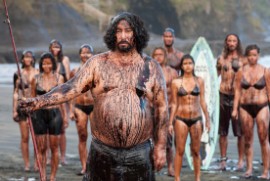
Elsewhere the magazine records that Greenpeace has called on the NZ government to permanently stop all plans to open up NZ’s coastal waters to offshore oil drilling and stop any expansion of coal mining. A petition to that effect is under way. Two actions have highlighted the call. A group of volunteers smeared with fake crude emerged from the sea at Muriwai in July (pictured). A few days later a bathing-gear-clad group similarly smeared walked through downtown Wellington to deliver the first 18,000 signatures of the petition along with Greenpeace’s submission on the Review of the Crown Minerals Act.
Greenpeace NZ’s campaign against Fonterra for the dairy industry’s use of palm kernel grown on areas of destroyed rainforest has received media coverage, particularly through their disruptive action at the Auckland Fonterra offices. The magazine reports the evasiveness of Fonterra CEO Andrew Ferrier when asked if Fonterra supported deforestation in Indonesia “…we’ve got, um, plenty of people in our comms department that you can talk to about that.” The “comms people” were meanwhile putting out a statement mentioning Fonterra’s supply partner who “we believe follows industry best practice in responsible sourcing.” Greenpeace comments dryly that “we believe” is corporate speak for “don’t ask, don’t tell”. Typically Greenpeace were on the ground in Indonesia, researching the continued destruction of rainforest by the palm industry and the magazine includes Communications Manager Suzette Jackson’s account of her 27 hours in jail when caught documenting the evidence of widespread destruction.
These examples from the recent magazine are of course just the tip of the iceberg for Greenpeace’s ongoing activism on climate change backed by solid and well-researched reports such as one on the clean energy future possible for New Zealand, or the Greenpeace International publications on their climate vision. From the international level the magazine carried some remarks by Kumi Naidoo who became the Executive Director of Greenpeace in 2009. He describes climate change as without question the greatest threat any generation has had to face, and at one point speaks of the role of civil disobedience, often present in Greenpeace actions, in awakening governments to action on such a crucial matter.
“History tells us that whenever injustice arises – whether that be related to civil rights in the United States, New Zealand’s nuclear-free movement, a woman’s right to vote, Parihaka or the anti-Springbok tour protests – it was only when determined men and women were prepared to stand up and say, ‘Enough is enough, I am prepared to peacefully break the law and even go to prison to get our message across’, that change finally happened.
“When all other attempts at negotiation or discussion have faltered, organisations must have the option of turning to civil disobedience and non-violent direct action.”
It is this preparedness that gives Greenpeace’s advocacy the seriousness that climate change demands. All power to them as they continue the battle determinedly in the year ahead.

 Lester Brown has for years been unwavering and persistent in drawing attention to the gathering environmental dangers humanity faces and pointing to the alternative practices which might yet save us from the worst effects. His widely read Plan B books have appeared at regular intervals throughout the last decade. I reviewed the fourth of them on Hot Topic in 2009. A new book now published is shorter but no less urgent, as its title indicates: World on the Edge: How to Prevent Environmental and Economic Collapse.
 The southern summer silly season is here, and newspapers are desperate for copy. That’s about the only good reason I can think of for the nation’s biggest-selling newspaper, Auckland’s
  Over the holiday period I’ve had a number of people point me at the latest “essay” by Don “
