Cambridge on ice

[youtube]M5nXSC1woLU[/youtube]

From Cambridge University: the director of the Scott Polar Research Centre, Prof Julian Dowdeswell talks about his job. He has to visit Greenland and Antarctica to measure glaciers, so there are lots of pretty pictures to watch. Not a bad job, even if the implications of what he’s finding (Greenland outlet glaciers doubling in speed) are worrying…

Let the wind blow (again)

Lester Brown doesn’t let up when he’s published a book. Over successive months his Earth Policy Institute produces follow-up articles focusing on particular topics. The latest is on wind power, which was strongly advocated in his recent book World on the Edge as the early leader in the move to renewable sources of energy. What he has to say about the global development of wind power ties in with my recent update on wind power in New Zealand and is well worth reporting here. What follows is mainly extract from his article.
There are now more than 70 countries developing wind resources. Between 2000 and 2010, world wind electric generating capacity increased at what Brown describes as frenetic pace from 17,000 megawatts to nearly 200,000 megawatts.

Continue reading “Let the wind blow (again)”

Garnaut: no reticence on risk

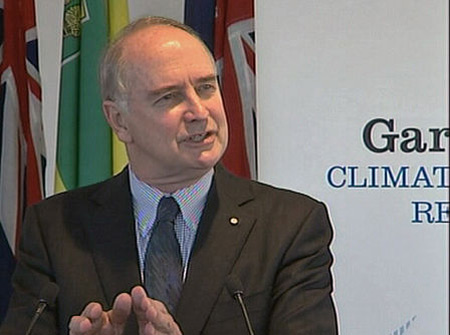
I appreciated the candidness with which economist Ross Garnaut introduced and concluded his recently released update on the science of climate change, one of a series of updates to his 2008 Review which have been commissioned by the Australian government. In the introduction he explains how he began his original Review with no strong views and no more than a common knowledge of climate change science. He read a fair bit of climate science in the course of preparing the Review, including paying due attention to sceptics with genuine scientific credentials, and his investigations led him to the premise for his Review that “on a balance of probabilities” the central conclusions of the mainstream science were correct.

Since then he has moved in his thinking to regard it as highly probable that most of the global warming since the mid-20th century is human-caused. Further, he declares that he would now be tempted to say that those who think that temperatures and damage from a specified level of emissions over time will be larger than is suggested by the mainstream science are much more likely to be proven correct than those who think the opposite.

Continue reading “Garnaut: no reticence on risk”

McLean’s folly and the climate clueless

In an astonishing press release issued last week, the New Zealand Climate “Science” Coalition predicts that 2011 will be the “coolest year globally since 1956 or even earlier”. The C”S”C bases its prediction on the work of Australian “computer consultant and occasional travel photographer” John McLean. Hot Topic readers will remember McLean as the lead author of a rapidly rebutted 2009 paper (written with Chris de Freitas and Bob Carter) which claimed that El Niño/Southern Oscillation (ENSO) events were a driver of global temperature increases. I covered the full story at the time: see Mother Nature’s Sons and subsequent posts.

One unoriginal finding of the McLean paper was that global temperatures were affected by ENSO events — warming after El Niños and cooling after La Niñas. Last year NZ C”S”C member Bryan Leyland used this to “predict” a coming cooling, which was lapped up by the usual suspects. In January this year, Leyland predicted cooling would continue until at least June. Now McLean has taken this a step further by predicting that temperatures will plunge to that of a cool year 50 years ago. There’s no justification for this prediction in the press release, beyond McLean pretending that his 2009 paper showed that CO2 was a minor player in global temperature change.

Unfortunately for the credibility of all involved, McLean’s prediction is utter unphysical nonsense. Here’s why…

Continue reading “McLean’s folly and the climate clueless”

Whispering wind #2

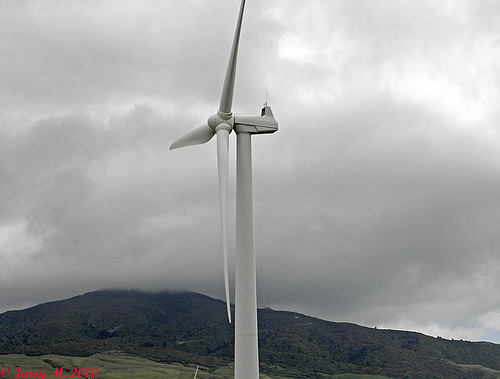
The arrival of a Wind Energy Association Newsletter suggested it might be time for an update on wind power in New Zealand. It’s nearly two years since I wrote about wind farm prospects in my own Waikato region. The first of those wind farms, at Te Uku, is now up and running. The Prime Minister was present at the opening on 11 February, and is reported by the wind energy association as saying “In a world where we want to get away from fossil fuels and ultimately have a cleaner, greener environment, wind is a tremendous technology for us.”

The newspaper report, however, failed to report that remark and focused on his use of the occasion to defend the Government’s wish to privatise up to 49% of Meridian Energy. It also reported him as saying that new technology and generation such as Te Uku would only be introduced “when it pays for itself”. One would like to think that at this point he pointed out that fossil fuel-generated electricity doesn’t pay for itself but is heavily subsidised by future generations, but if he did the paper didn’t think it newsworthy.

Continue reading “Whispering wind #2”